A military wedding ceremony script
Runtime: 18–22 minutes, plus the arch
Updated August 2026
A military wedding is a wedding with a second set of customs running alongside it, and the officiant’s job is to let both of them work without either getting in the other’s way. This is a complete military wedding ceremony: the full script from processional to recessional, written around the honor guard, the arch of sabers or swords, and the practical constraints a dress uniform puts on a day.
Practice varies by service, by unit, and by venue, so nothing here is offered as a rule. Where customs differ, the officiant’s notes say so and send you to the people who actually decide: the couple, their unit, whoever leads the detail, and the venue. Confirm each of those before you print, and never quote a regulation you have not read.
The ceremony, step by step
Before the guests arrive
the hour beforeThe block nobody schedules and every military wedding needs. Do it in person, on the actual ground, with the person who will be running the detail.
[The officiant meets whoever is leading the honor guard or the saber detail, walks the space where the arch will form, and agrees the signal that starts it and where the officiant should stand while it runs.]
[To the detail leader, before guests arrive: Where do you want them standing, what is your signal, how much room and headroom do you need, and what do you want from me?]
[The couple confirms how each of them is to be named in the introduction, including whether either wishes to be addressed by rank at any point, and the officiant writes both forms phonetically onto the script.]
Processional
2–3 minAsk rather than assume. Some couples want the party in uniform to enter in a particular order, and some want nothing of the kind. Music and marching timing are the venue’s call and the detail’s together.
[Guests are seated. Any honor guard takes its position. The wedding party enters, then the couple. Everyone remains standing until the officiant invites them to sit.]
Welcome
2 minWarm and steady. Check the microphone on your first sentence, and if the ceremony is outdoors, find out before you speak which way the wind is going.
Good afternoon, everyone, and welcome. Please, be seated.
We are here for the marriage of [Partner A] and [Partner B]. There are two kinds of promise in this room today. One of them was made before any of us arrived: a promise to serve, which has already cost this couple time, distance, and a great many ordinary evenings they never got back. The other is the promise they are about to make to each other.
Both are worth honoring properly, so today we will do exactly that, and we will not rush either one of them.
On service and marriage
2–3 minSpeak about this couple, not about the military as an institution. Nothing here should sound like a recruiting speech, and if you are unsure whether a phrase is right, ask the couple rather than a search engine.
[Partner A] and [Partner B], a great deal of what a marriage asks, the two of you have already been doing at a distance: keeping faith with somebody who is not in the room, holding a shared life together across time zones, and learning to say the important things inside whatever short window you actually get.
[Add one short, true story from your conversation with the couple here.]
What changes today is not how much you love each other. What changes is that you stop doing it privately and start doing it in front of witnesses, with everything that entails.
Those who are not here
1–2 minOptional, and entirely the couple’s decision. Some want a seat, a place setting, or a silence for those who could not come or did not come home; others find it too heavy for a wedding day. Ask well in advance and follow the answer exactly, including a no.
[If the couple has chosen to mark those who are absent, it happens here, in whatever form they chose.]
[If the couple has asked for it: Before the promises, we take a moment for the people who could not be with us today, and for those who did not come home. Their absence is part of this family’s story, and it belongs here too.]
[A short silence, if the couple asked for one. The officiant ends it clearly rather than letting it drift.]
Declaration of intent
1 minAsk each partner in turn and wait for the answer. Keep both questions identical so the room hears the symmetry.
[Partner A], do you take [Partner B] to be your [wife / husband / partner], to love and to stand with through deployments and homecomings, through the postings you choose and the ones that choose you, for as long as you both shall live?
[Partner A]: I do.
And [Partner B], do you take [Partner A] to be your [wife / husband / partner], to love and to stand with through deployments and homecomings, through the postings you choose and the ones that choose you, for as long as you both shall live?
[Partner B]: I do.
The vows
2–3 minSlow right down. Standing still in dress uniform is harder than it looks, so keep this block moving even while you slow the delivery, and watch for anyone in the party going pale.
Please face each other and join hands. [Partner A], repeat after me.
I, [Partner A], take you, [Partner B], to be my [wife / husband / partner]. I promise to keep telling you the truth across whatever distance we are given, to make the time we do have count, and to come home to you in every way a person can. From today, wherever either of us is sent, I am yours.
And [Partner B], repeat after me.
I, [Partner B], take you, [Partner A], to be my [wife / husband / partner]. I promise to keep telling you the truth across whatever distance we are given, to make the time we do have count, and to come home to you in every way a person can. From today, wherever either of us is sent, I am yours.
The rings
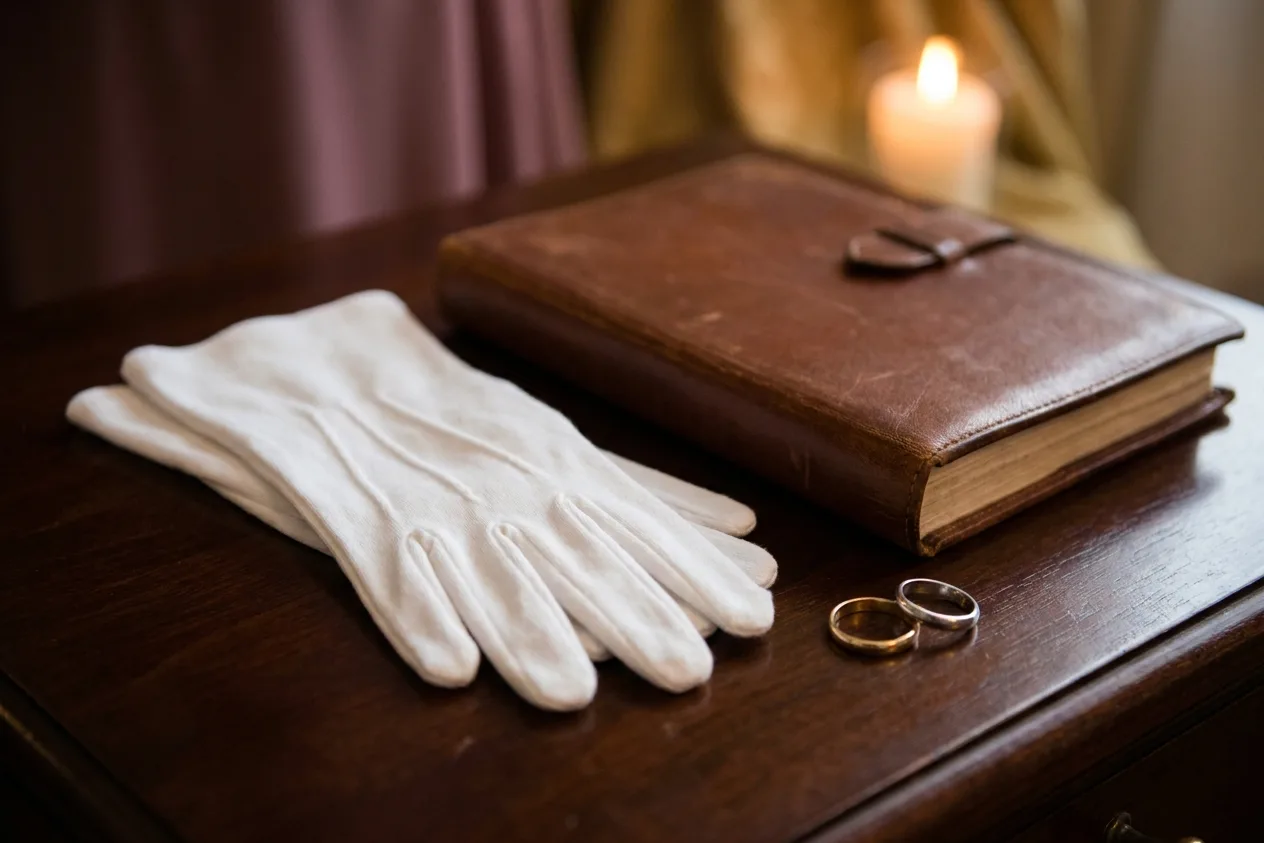
1–2 minGloves come off before the rings, so build a beat in for it. Agree in advance who is holding them and where they go afterward, because dress uniforms rarely have a convenient pocket. [Pause for the rings.]
May we have the rings, please.
You will both wear these in places the other one cannot follow. Let each ring be the plainest possible reminder, on a hand you use all day, of the promise made here in front of everyone who loves you.
[Partner A], place the ring on [Partner B]’s finger and repeat after me.
I give you this ring as the sign of everything I promised today. Wherever I am, I am yours.
And [Partner B], repeat after me.
I give you this ring as the sign of everything I promised today. Wherever I am, I am yours.
Pronouncement
1 minLift your voice for the peak, then pause before the kiss so the room can catch up. Use exactly the names and forms of address the couple gave you, and no others.
[Partner A] and [Partner B], you have declared your intention in front of all of us, made your promises to each other, and sealed them with rings. And so, by the power vested in me by the [state / jurisdiction], it is my great joy to declare that you are married.
You may share your first kiss as a married couple.
[The couple kisses, to applause. The officiant lets it crest.]
Recessional and the arch
3–5 minThe arch belongs to the detail, not to you. Hand it over cleanly: announce the couple, step well back, and let the detail leader run it. Do not narrate it, and never walk under it ahead of the couple.
Friends and family, please welcome, for the very first time, [the newly married couple, announced exactly as they wish].
[The couple turns to leave. Where there is a saber or sword detail, it forms the arch on the detail leader’s command, and the couple passes beneath it. The officiant stays back and lets the detail work.]
[Some units add a light tap of the blade and a spoken welcome as the couple passes through. Whether that happens at all, and in what words, is the detail’s custom and the couple’s choice. Confirm both in advance rather than discovering them during the recessional.]
Officiant’s notes
What you coordinate, and what you must not invent
The single most useful thing in a military wedding ceremony script is a clear line between what the officiant runs and what the officiant does not. You run the ceremony. The detail runs the arch. Whoever leads that detail decides how many members are in it, whether they carry sabers or swords, how they are positioned, what the command is, and whether any words are spoken as the couple passes through. All of that varies by service, by unit, and by what the detail actually has available, so ask them and write down the answer instead of assuming the version you saw somewhere else.
Uniform questions belong to the couple and their unit, never to you. What may be worn, what may be added to a uniform, and how the wedding party in uniform is dressed are governed by each service’s own rules, and those rules are not yours to interpret. If a couple asks you what is allowed, tell them plainly that you do not know and point them at the people who do. An officiant who guesses at protocol in front of a room that includes serving members has spent credibility that the rest of the ceremony needs. Where practice varies, say it varies. Nobody minds being told to confirm something.
Uniforms, heat, and a plan that survives a change of orders
A dress uniform is a warm, heavy, stand-up-straight garment, and a wedding party wearing one outdoors in summer is on a clock whether anyone says so or not. Keep the ceremony to about twenty minutes, ask for shade and water for anyone standing, watch the party rather than only the couple, and know before you begin what you will do if somebody needs to sit down. Say it plainly at the rehearsal: anyone who needs to step out should step out, and nothing about the ceremony will pause or comment.
Then build a plan that can move. Military weddings change date more often than most, because orders, leave, and deployments do not negotiate. Talk about that openly and early: agree what happens if the date shifts, and discuss whether the couple wants a short legal ceremony beforehand with the large one held later. Confirm the license requirements with the county clerk for the place the ceremony is actually happening, and where the wedding is on an installation, ask the chapel office about scheduling, guest access, and their own process, since it can work differently. Get every name, rank, and unit written phonetically on your page, and read the whole script aloud once, timed.
Write and perform every ceremony from one desk
RiteBinder is the booking desk and the writing desk in one: interview the couple, draft and personalize the script, and read from a podium that needs no signal on the day. Free to start.
Frequently Asked Questions
- What is the arch of sabers or swords?
- It is a tradition in which members of the couple’s service form an arch of raised blades for the couple to pass beneath as they leave. Whether they are sabers or swords, how many take part, and what is said as the couple passes all vary by service and by unit. The detail leader runs it and gives the commands; the officiant announces the couple and steps back.
- Who arranges the honor guard?
- The couple does, usually through their own unit or the friends they want in the detail. The officiant coordinates around it rather than commanding it. Your part is to meet the detail leader before the guests arrive, walk the space, agree the signal that starts the arch, and find out where you should be standing while it runs.
- Can we wear our uniforms at the wedding?
- That is decided by each service’s own rules and by the member’s unit, not by the officiant or the venue. Ask the unit directly, well ahead, including any question about what may be added to a uniform. An officiant should never answer this from memory, and a couple is better served by an honest "ask them" than by a confident guess.
- How long should a military wedding ceremony be?
- Shorter than you might otherwise write it, especially outdoors. Twenty minutes or so is kind to a wedding party standing still in dress uniform, and this script is built to run eighteen to twenty-two plus the arch. Ask for shade and water, watch the party during the vows, and make it clear at the rehearsal that anyone can step out without comment.
- Does a wedding on a base work differently?
- It can. Chapel scheduling, who may officiate there, guest access, and the paperwork process are all handled through the installation, and they do not necessarily match what a civilian venue would do. Ask the chapel office early, and confirm the marriage license requirements separately with the county clerk who issues the license.