A complete wedding ceremony script
Runtime: 18–22 minutes
Updated October 2026
This is a complete wedding ceremony script: every word from the processional to the recessional, with the officiant’s stage directions and a timing estimate beside each block. Read it start to finish and you have a ceremony you could perform on Saturday. Lift the parts you like and it becomes a frame for your own.
The bracketed names are yours to replace, and the notes in the margin are the small, hard-won cues that keep an officiant steady at the front of the room. Where a couple wants a different flavor — no religion at all, a handfasting, a renewal, or something short — the pointers along the way lead to a complete script for that, too.
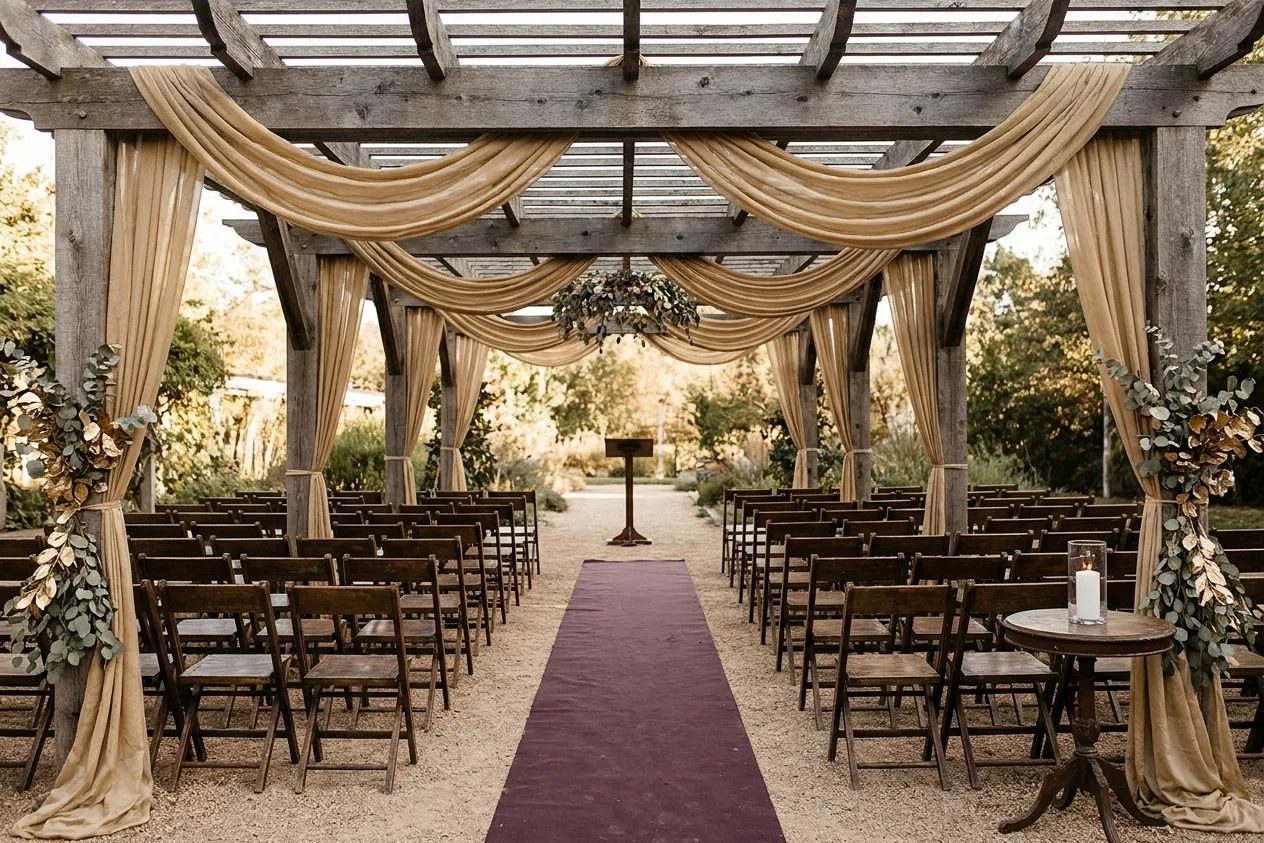
The ceremony, step by step
Processional
2–3 minStand to one side so the aisle and the couple stay the focus. Don’t speak over the music. Wait until everyone has reached their place and the room has settled.
[Guests are seated. The wedding party enters, then the couple. Everyone remains standing until the officiant invites them to sit.]
Welcome
1–2 minWarm and unhurried, looking at the guests, not your page. Check your mic level on the first sentence. This is where the room exhales and turns toward the couple.
Good evening, everyone, and welcome. Please, be seated.
We’re here today for the happiest of reasons: to witness and celebrate the marriage of [Partner A] and [Partner B]. Every person in these seats was chosen. You are the people who have shaped these two lives, and they wanted your faces in front of them for this. On their behalf, thank you for being here.
A wedding is a rare thing — one of the few days a family gathers everyone it loves into a single room and asks them to hold a moment together. So let’s be fully here for it, phones down and hearts open, for these next few minutes that belong to [Partner A] and [Partner B].
On this marriage
2–3 minSpeak about THIS couple, not marriage in the abstract. Replace the bracketed line with one true detail from your interview; the room will feel the difference.
[Partner A] and [Partner B], the promise you’re about to make is a large one, and you’re making it with your eyes open. Marriage isn’t the end of a love story; it’s the decision to keep writing one, together, on the ordinary days as much as the extraordinary ones.
What everyone who knows you notices is how much lighter you are together — quicker to laugh, braver, more yourselves. [Tell one short, true story from the couple’s interview here: how they met, the moment one of them knew, a small daily kindness.] That is the thing you’re protecting today, and it is worth protecting.
You’re not promising to be perfect for each other. You’re promising to be present — to choose each other again on the good mornings and the hard ones, and to build, day by day, a home the rest of us are glad to visit.
The reading
1–2 minOptional. One reading is plenty; two starts to sag. Cue your reader by name, wait for them to reach the front, and thank them as they sit back down.
[If there is a reading, the officiant invites the reader forward now.]
Before [Partner A] and [Partner B] make their promises, [Reader’s name] is going to share a few words they chose for today.
[The reading is given. The officiant thanks the reader by name as they return to their seat.]
Declaration of intent
1 minShort and load-bearing. Ask each partner in turn, and wait for the “I do” before you move on. Let the room hear each answer.
[Partner A], do you take [Partner B] to be no one but themselves — to love what you already know of them, and to stay curious about what you don’t; to stand with them in good fortune and in hard times; and to choose this marriage, on purpose, every day for the rest of your life?
[Partner A]: I do.
And [Partner B], do you take [Partner A] to be no one but themselves — to love what you already know of them, and to stay curious about what you don’t; to stand with them in good fortune and in hard times; and to choose this marriage, on purpose, every day for the rest of your life?
[Partner B]: I do.
The vows
2–3 minThe emotional center. Whether the couple wrote their own or repeat these, slow right down and let each phrase land. Watch the couple, not your page.
Now, [Partner A] and [Partner B], you’ll make your promises to each other. Please face one another and join hands.
[The couple turns to face each other and joins hands. If they wrote their own vows, they read them now. Otherwise the officiant leads each partner through the lines below, a phrase at a time.]
[Partner A], please repeat after me.
I, [Partner A], take you, [Partner B], to be my [wife / husband / partner]. I promise to stand beside you and never in your way; to be your shelter and your adventure; to tell you the truth gently, and to listen for yours. From this day on, whatever comes, I’m yours.
And [Partner B], please repeat after me.
I, [Partner B], take you, [Partner A], to be my [wife / husband / partner]. I promise to stand beside you and never in your way; to be your shelter and your adventure; to tell you the truth gently, and to listen for yours. From this day on, whatever comes, I’m yours.
The rings
1–2 minKnow who is holding the rings before you ask. If a ring sticks, smile and keep going. Everyone remembers the warmth, not the fumble. [Pause for the rings to be brought forward.]
May we have the rings, please.
[The rings are brought forward. The officiant may hold them up briefly so the guests can see them.]
A wedding ring is a small, plain circle, and yet we hand it enormous meaning: it has no beginning and no end, and it’s worn where the whole world can see it. Each time you catch it on your hand, let it bring you back to the promise you’re making here, in front of everyone who loves you.
[Partner A], place the ring on [Partner B]’s finger and repeat after me.
I give you this ring as a sign of my love and everything I’ve promised today. Wear it, and know that you are mine and I am yours.
[Partner B], place the ring on [Partner A]’s finger and repeat after me.
I give you this ring as a sign of my love and everything I’ve promised today. Wear it, and know that you are mine and I am yours.
Pronouncement
1 minLift your voice: this is the peak. Pause a beat after “married” before you invite the kiss, so the room can catch up. [Let the applause come; don’t talk over it.]
[Partner A] and [Partner B], you’ve declared your intention in front of all of us, made your promises to each other, and sealed them with rings. And so, by the power vested in me by the [state / jurisdiction], it is my great joy to declare that you are now married.
You may share your first kiss as a married couple.
[The couple kisses. The officiant waits for the applause to crest before speaking again.]
Recessional
1 minIntroduce them exactly the way they asked to be named. End high and get out of the way; the celebration starts the moment you stop talking.
Friends and family, it’s my privilege to introduce, for the very first time, [the newly married couple, announced as they wish].
[The couple leads the recessional back up the aisle, followed by the wedding party. The officiant follows last.]
Officiant’s notes
How to make this script your own
Treat every bracket as a question for the couple, not a blank to guess at. The names, the pronouns in the vows, how they want to be introduced, whether there’s a reading and who gives it — these are the details a couple clocks instantly, and getting them right is what tells them you were paying attention. Confirm the pronunciation of every name you’ll say aloud and write it phonetically into your copy, right where the name appears, so you’re never guessing at the front.
The one block you should never perform from a template is the address. Replace the bracketed story with a real, specific moment from your conversation with the couple: the unglamorous daily thing that says more than any grand gesture. One true detail, said plainly, does more than a paragraph of beautiful generalities. Everything else here is a reliable frame you can lean on; that single story is what makes the room go quiet.
Reading it well on the day
Read the whole thing aloud, standing, at least once before the day. Your ear catches what your eye skims past: the sentence that runs out of breath, the transition that lurches, the name you keep tripping on. Time yourself as you read. This script runs about eighteen to twenty-two minutes, and if a couple wants it shorter, trim the reading or tighten the address before you touch the vows.
Sound is the most common ceremony failure, so settle it early: ask whether there’s a microphone for the officiant, test it before guests arrive, and if there’s none, plan to project to the back row; outdoors, factor in wind and distance. Mark your pauses and cues right in the script, stand slightly to one side so the couple stays the picture, and print it large or load it onto a screen that needs no signal, so a dead phone or bright sun never leaves you squinting. When something small goes sideways (and it will), keep your composure; the room takes its steadiness from you.
Adapting this script
This is a full ceremony: use it as the spine and cut or swap to fit the couple.
For a second marriage, the honest move is one sentence that acknowledges the road: swap the opening’s "two lives beginning" line for "two people who know exactly what they are promising — and are choosing it anyway." Skip nothing else; the structure holds.
For a basic or civil ceremony, keep the processional, a two-sentence welcome, vows, rings, pronouncement, kiss. That’s a complete, legal ceremony in about five minutes; we keep two ready-to-perform versions in short and simple wedding ceremony scripts.
For couples renewing vows, don’t reuse a wedding script: the tense is wrong. The vow renewal ceremony script honors a marriage that already exists instead of announcing a new one.
To swap the vows, the couple can repeat these after you a line at a time, or say their own. The wedding vows library carries complete sets by tone alongside the method for writing your own, so they can hear a few aloud before choosing.
For the reading, settle the text before you finalize the address, or the two can end up saying the same thing. The wedding readings library prints each one in full with the year it was published and why it is free to use, which also settles whether it can go in the program.
Write and perform every ceremony from one desk
RiteBinder is the booking desk and the writing desk in one: interview the couple, draft and personalize the script, and read from a podium that needs no signal on the day. Free to start.
Frequently Asked Questions
- How long is this wedding ceremony script?
- Performed at an unhurried pace, the script itself runs about eighteen to twenty-two minutes, with the processional and recessional adding a few minutes on either end, the length most guests remember fondly. If you need it shorter, trim the reading and tighten the address before you touch the vows, or use the short and simple scripts for two ready-trimmed versions.
- Can I use this script for free?
- Yes. Read it here, print it, or save it as a PDF at no cost, with nothing to sign up for. It’s written to be performed and adapted: change the names, the pronouns, and the vows to fit the couple in front of you, and lift only the parts you want.
- Is this a religious or non-religious ceremony?
- As written it’s warm but non-denominational; it names no faith and suits most couples. For a version with no religious framing of any kind, use the complete non-religious wedding ceremony script; to add a spiritual or ritual element, the handfasting script folds one in.
- Do the couple have to write their own vows?
- No. The vows here are complete and ready to repeat after you, a line at a time. If the couple would rather write their own, keep everything else and simply give them the floor at the vows block. Plenty of couples do a mix: your framing, then their own words.
- Can I change the wording?
- Please do. This is a starting point, not a fixed rite. Reorder the blocks, swap a phrase for one that sounds like you, cut anything that reads as filler. The words that get spoken should be the ones you chose for these two people.