Updated July 2026
Funeral and celebrant work: the adjacent revenue
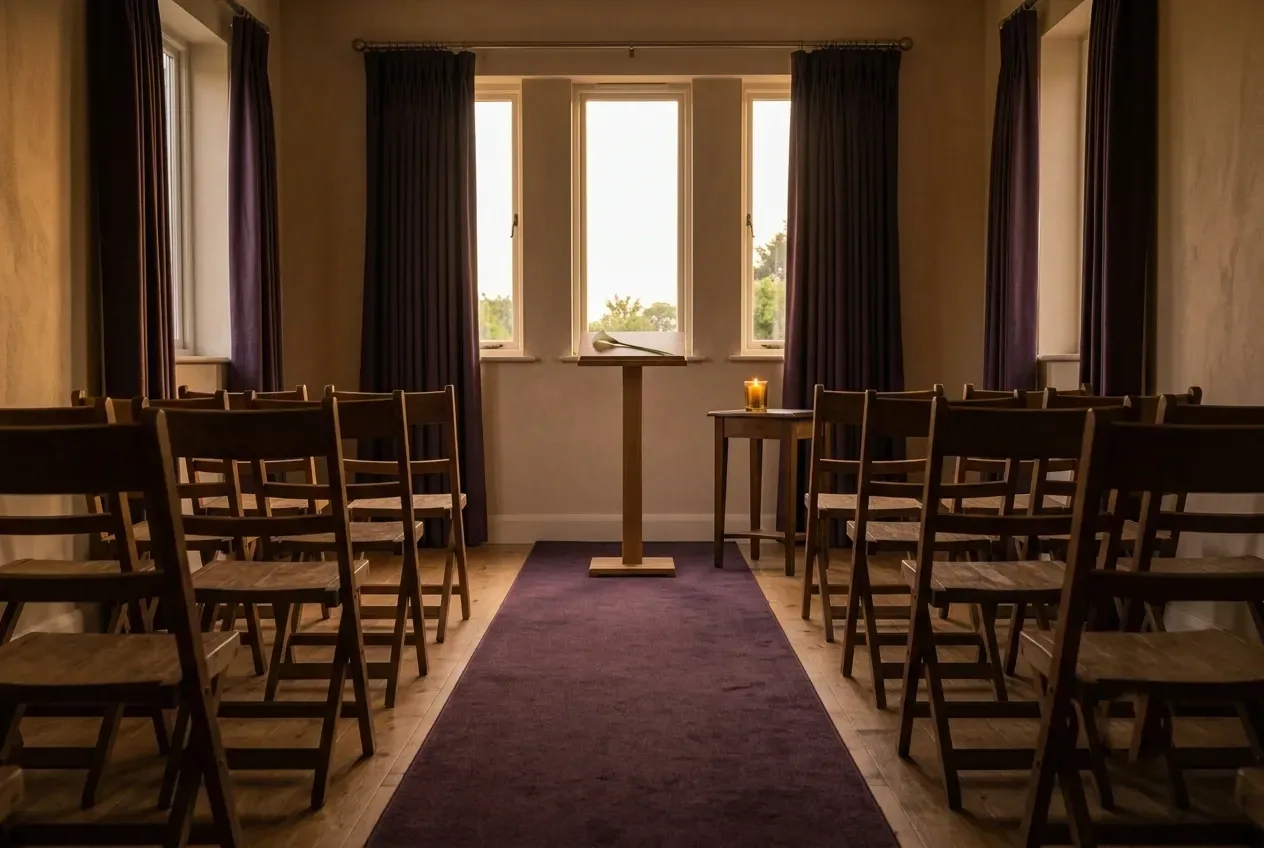
You already know how to sit with two people, learn what matters to them, and stand in front of a room to say it out loud. That skill does not only belong to weddings. Families need someone to lead a funeral, a memorial, a naming, or a vow renewal, and most of the year those families have no June-to-October season to wait for. If you officiate weddings, you are closer to this work than you think.
This chapter is about the ceremonies next door to the one you already do: what a funeral or memorial celebrant actually does, what the work pays, what credentials it does and does not require, and why adding it to a wedding practice makes both your calendar and your craft stronger. It also covers the part that matters most, which is how leading a grieving room is different from leading a joyful one, and how to hold that difference with care.
What a funeral or memorial celebrant does
A funeral or memorial celebrant meets a family, learns the story of the person who died, writes a service that fits that person, and leads the gathering with a steady presence. The shape rhymes with wedding work, but the register is quieter and the stakes feel immediate.
The first meeting is an interview, the same core skill you use with a couple. You sit with the family, often several people at once, and you listen. You ask about the life: the work they did, the people they loved, the small habits that made them themselves, the contradictions, the humor. You gather the readings, the music, the names that must be spoken, the order of who wants to speak. You are building a portrait, and the family is trusting you to get it right when they are least able to do the assembling themselves.
Then you write. You shape a eulogy or tribute, weave in the readings and remembrances, and build an order of service that carries a room from arrival to farewell. You personalize it the way you personalize vows: this life, these words, no template that could belong to anyone else. Our chapter on the craft of writing a ceremony script covers the mechanics of building and pacing a service, and nearly all of it transfers directly to a memorial.
On the day, you lead. You open the gathering, hold the structure, invite speakers, cover the silences when someone cannot go on, and bring the room to a close with something to carry out the door. You are the calm center. When you have done it well, the family barely remembers you were steering, only that they were held.
What celebrants charge
Funeral and memorial celebrants commonly charge about $250 to $1,000, with many independent celebrants and fees quoted through funeral homes clustering around $300 to $500, per Ever Loved and funeral-industry cost guides (2025).
A few things shape where you land in that range. Funeral homes often present a celebrant fee as a line item on the family’s arrangement, which tends to sit toward the middle of the band. Independent work you book directly can price higher, especially when the family wants a fully written, personalized service rather than a brief officiated reading. The compressed timeline matters too, and we will come back to that, because the work is often done in a handful of days and that intensity is part of what you are pricing.
Treat these figures as a real sourced range, not a fabricated precision. Your own rate will depend on your market, how much writing the family wants, and how you position the service. For how to set and communicate a number without apology, see pricing-your-services. The short version: this is serious work done under pressure and grief, and it should be priced as such.
Credentials: what you need and what you do not
Here is the part that surprises most wedding officiants. A funeral generally requires no license and usually not the same registration a wedding does.
A wedding is a legal act. Someone with standing has to solemnize the marriage and sign the license so the state recognizes it, which is why wedding officiants care so much about registration and who is authorized where. A funeral or memorial carries no such legal instrument. There is no license to sign, no vow to solemnize, no office you must be registered to hold. The gathering is a human and often spiritual event, not a state one.
That means many celebrants lead funerals and memorials with no extra credential beyond their own skill and standing. If you already officiate weddings, you already have the presence and the writing ability that the work asks for. You can begin without a new certificate.
Some celebrants do pursue formal celebrant training, and there are respected programs that teach the specific craft of memorial work, grief-aware interviewing, and secular ceremony design. Training can sharpen your interview, deepen your comfort with grief, and give you language and structure to lean on. It can also help you market yourself and get referrals from funeral homes that prefer a trained name. It is worth considering, but understand it as an investment in craft and credibility, not a legal gate you must clear before you can serve a family. The honest answer to “how do I become a funeral celebrant” is that you can start by doing the work well, and pursue training if and when it serves you.
Why add it to a wedding practice
Two reasons, and they reinforce each other.
It is counter-seasonal
Weddings cluster. Depending on your region, the calls come in a warm-weather rush and then go quiet, and that quiet stretch can be long. Funerals do not follow a season. People die year-round, and families need a celebrant in January as much as in July. Memorial work fills the months when wedding inquiries slow to a trickle, which smooths your income across the year instead of leaving you to live off a few busy months.
Vow renewals and naming ceremonies round out the picture. A renewal is close cousin to a wedding and often lands in the shoulder seasons. A naming, welcoming a child without requiring a religious rite the family may not want, is another warm, personal ceremony you are already equipped to write and lead. None of these are seasonal in the way weddings are, and together they turn a summer trade into a year-round practice.
The skills transfer directly
You are not learning a new profession. You are pointing the same craft at a different occasion. The interview, sitting with people and drawing out what matters, is the same muscle you use with a couple. The writing, shaping a life and a set of readings into a service that moves, is the same muscle you use for vows and a ceremony script. The presence, holding a room with warmth and steadiness, is exactly what you already do at the front of an aisle. What changes is the emotional weather, and that is learnable.
There is also the meaning of it. Wedding officiants often say the work matters to them because they get to stand with people on the best day of their lives. Memorial work sits at the other end of the same human range, and many celebrants find it among the most rewarding things they do. You give a grieving family the gift of feeling their person was seen and said well. That is not a lesser version of ceremony work. For some officiants it becomes the heart of the practice.
If you want to think about how these ceremonies fit together as a single offering rather than separate side gigs, turning-it-into-a-business walks through building one practice that serves several kinds of days.
How funeral work is emotionally different
Everything above makes the extension sound smooth, and the craft really does transfer. But do not walk into a memorial expecting it to feel like a wedding with different music. It asks something different of you, and taking that seriously is part of doing it well.
The timeline is compressed
A wedding gives you months. A funeral gives you days. From the first call to standing in front of the room, you may have less than a week, sometimes only two or three days. You will do the interview, write the whole service, and prepare to lead it inside a window that leaves no room to circle back. This is why the work is intense and why it is priced the way it is. It rewards officiants who can listen fast, write clean, and trust their preparation. Having your materials, notes, and order of service organized in one place matters more here than anywhere, because there is no time to hunt for anything.
The register is quieter
A wedding room wants to be lifted. A grieving room wants to be held. You lower your voice, you slow down, you leave silence where a wedding would fill it. You are not performing joy; you are making space. Humor still belongs, because the best memorials laugh as much as they cry, but it is warmth in service of the room, never brightness laid over it. Reading the room, sensing when to move and when to wait, is the central skill, and it comes with reps.
You are holding a grieving room
At a memorial, you are the steady one when few others in the room can be. Someone will break down mid-tribute, and you will step in gently and carry the moment. The family will be exhausted and raw, and they are leaning on your calm. This is real emotional labor, and it can stay with you after you leave. Give it its weight. Take care of yourself around it. And price it as the serious work it is, not as a favor squeezed between weddings.
Serving every family evenly
Families come to memorials from every belief and none. Some want scripture, hymns, and a clear religious frame. Some want a fully secular service with poetry and music and not a single line of prayer. Many want something in between, a service that honors a tradition lightly without leaning on it. Your job is to serve whichever family is in front of you, on their terms, without importing your own assumptions in either direction.
Do not assume a family is religious, and do not assume they are secular. Ask. Listen for the language they use about the person and the gathering, and mirror it. A trained celebrant is often valued precisely because they can build a personal service for a family who does not want a religious officiant but still wants depth and structure. Being at ease with both the sacred and the secular is one of the most useful things you can offer.
The practical side helps here too. Whether the day is a wedding, a memorial, a renewal, or a naming, the underlying work is the same, one desk handling every ceremony a family brings you. That is the whole idea behind RiteBinder: every ceremony, one product, so the memorial you write next week lives in the same place as the wedding you led last month, kind-neutral and ready.
To step back and see where this fits in the larger picture of building a ceremony practice, return to the pillar. Funeral and celebrant work is not a detour from officiating. It is the rest of the year, and often the deepest part of the calling.
Frequently Asked Questions
- How much do funeral celebrants charge?
- Funeral and memorial celebrants commonly charge in the range of about $250 to $1,000, with many independent celebrants and the fees quoted through funeral homes clustering around $300 to $500 (per Ever Loved and funeral-industry cost guides, 2025). The fee typically covers meeting the family, writing and personalizing the service, and leading it. As with weddings, price the real hours, not just the time at the lectern.
- Do I need different credentials to lead a funeral?
- A funeral or memorial does not require a marriage license or, in most cases, the same registration a wedding does; there is no vow to solemnize. Many celebrants lead them with no additional credential beyond their skill, though some pursue celebrant training to deepen the craft. As always, secular and religious families both hire celebrants; the work is presented here without assuming either.
- Why add funeral and celebrant work to a wedding practice?
- Two honest reasons: it is work worth doing, and it is counter-seasonal. Funerals and memorials happen year-round, so they fill the quiet winter months when weddings thin out. Vow renewals, namings, and other life ceremonies do the same. The interviewing, writing, and presence you build on weddings transfer directly.
- Is funeral work emotionally different from weddings?
- Yes, and it deserves respect for that. The timeline is compressed (often only days), the register is quieter, and your job is to hold a grieving room with steadiness and care. Many officiants find it the most rewarding work they do. Go in prepared for the emotional weight, price it as the serious work it is, and give the family the same specific, true detail that makes any ceremony land.
Run every ceremony from one desk
RiteBinder is built for officiants — book the ceremony, write it with the couple or family, send a signed agreement with a deposit on your own links, and read from a podium that needs no signal.
Get this as a 7-day course
One short email a day, the whole start-to-first-job path, written for someone doing this for the first time. Unsubscribe with one tap, any time.
You're in. Day one lands within a day. Check the promotions tab if it hides.
That didn't send. Check the address and try once more.