An elopement ceremony script
Runtime: 8–12 minutes
Updated October 2026
An elopement has no audience, and that changes how a ceremony has to be written. There is no processional to fill, no crowd to warm up, no applause to carry a pause. There are two people standing very close to you, a photographer perhaps, a witness perhaps, and a great deal of quiet. This is a complete elopement ceremony built for exactly that.
It runs eight to twelve minutes, most of which the couple will spend looking at each other rather than at you. Every line is written to be said at conversational volume, in wind, on a trail, or in a small room. Replace the brackets, cut anything that sounds like performance, and it is ready to perform.
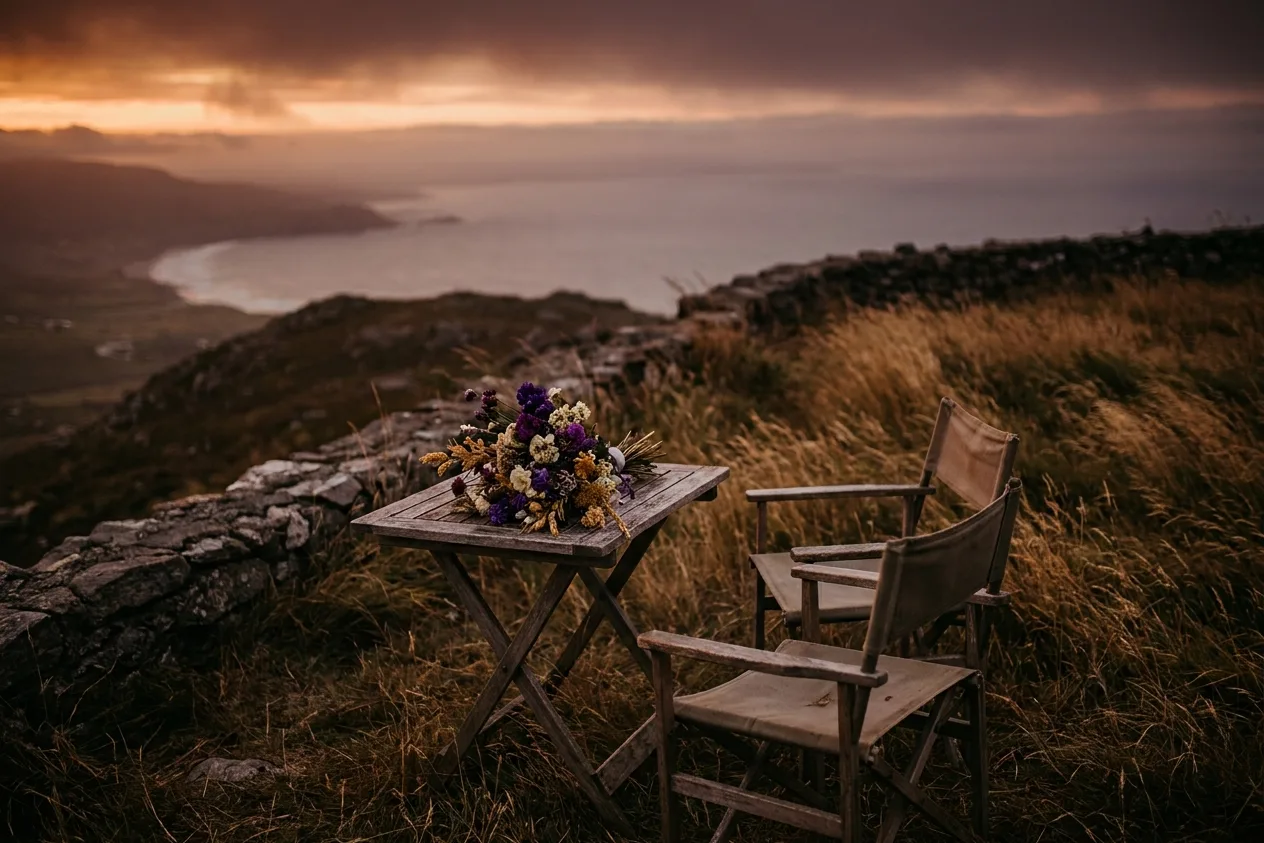
The ceremony, step by step
Arriving
1 minThere is no aisle, so the ceremony starts when you say it starts. Mark that clearly: turn to them, wait, and let the noise of getting here fall away before you speak.
[The couple, the officiant, and any witness stand together. There is no processional. The officiant waits until everyone has stopped moving and the couple is facing each other.]
Take a breath. Look at where we are for a second, and then look at each other. We can begin whenever you are ready.
Why here, and why just us
2 minSpeak at conversational volume. You are two feet from two people, not addressing a room. Do not project, do not perform, and do not use a voice they have never heard you use.
[Partner A] and [Partner B], you could have done this in front of two hundred people. You chose this instead: this place, this hour, and nobody watching but [the witness / the two of us / the mountains].
That is not a smaller wedding. It is a wedding with everything optional taken out of it, which leaves only the part that was ever load-bearing: the two of you, and what you are about to promise each other.
[Say one true thing here about why they chose this place. It is the only address you get, and twenty seconds is the right length for it.]
What you are choosing
2 minKeep looking at them, not at the view. The landscape is doing its own work and needs no help from your adjectives.
Marriage is not one enormous decision made on one day. It is a small decision made daily, usually in an ordinary kitchen, usually when neither of you is at your best. Today you are making the first of those decisions out loud, and every one after this will be quieter and will matter just as much.
Nobody is here to be impressed. There is no seating plan and no audience to satisfy. Whatever you say next, you are saying because you mean it, which is the whole reason you came all this way to say it here.
Declaration of intent
1 minEven with nobody watching, ask it as a real question and then stop. The pause before the answer is the ceremony.
[Partner A], do you take [Partner B] to be your [wife / husband / partner], to love and to look after, in easy years and hard ones, for as long as you both live?
[Partner A]: I do.
And [Partner B], do you take [Partner A] to be your [wife / husband / partner], to love and to look after, in easy years and hard ones, for as long as you both live?
[Partner B]: I do.
The vows
2–3 minHand it over completely. Step back half a pace if the ground allows it. Most eloping couples write their own; if they did not, lead them a phrase at a time and keep your voice low.
[The couple joins hands. If they wrote their own vows, they speak them now, in whichever order they agreed. Otherwise the officiant leads each of them through the lines below.]
[Partner A], repeat after me.
I take you, [Partner B], with nobody watching and nothing to prove. I promise you my honesty, my patience, and my company on every ordinary day after this one. Wherever we end up, I am going there with you.
And [Partner B], repeat after me.
I take you, [Partner A], with nobody watching and nothing to prove. I promise you my honesty, my patience, and my company on every ordinary day after this one. Wherever we end up, I am going there with you.
The rings
1–2 minCold hands and wind make rings stick and drop. Keep them in a zipped pocket rather than on a rock, and let the couple manage the ring themselves rather than reaching in to help. [Pause.]
You brought rings. Put them on each other now, and say this as you do.
This is the sign of what I promised, in a place we will both remember.
[Each partner places a ring on the other’s hand. The officiant stays quiet through the fumbling; it always takes longer than expected.]
A minute of quiet
1 minThis block replaces the applause. An elopement has a hole where a crowd’s reaction should be, and a silence named out loud and held on purpose fills it far better than more talking does.
Before I finish, I am going to stop talking for a moment. Stay exactly where you are and just be here.
[The officiant stops speaking for a slow count of twenty. Nobody fills the silence, including the photographer, who should be told about this block in advance.]
Pronouncement
1 minDo not lift your voice the way you would in a room; there is no back row to reach. Say it warmly and straight to them, and let it be the quietest big moment you will ever deliver.
[Partner A] and [Partner B], you have said what you came all this way to say. By the power vested in me by the [state / jurisdiction], I am glad to tell you that you are married. Kiss your [wife / husband / partner].
[The couple kisses. The officiant lets the moment run long.]
Signing, and the first minutes after
1–2 minKnow the witness rule before you travel, and sign somewhere flat and out of the wind, in a folder, with a pen that works in the cold. Then leave them alone for a while.
[The couple, the officiant, and any witness sign the marriage license. The officiant checks every field before the folder closes.]
That is the paperwork finished. I am going to walk back down and leave you two on your own for a while. Congratulations, both of you.
Officiant’s notes
Writing for an audience of two
Almost everything an officiant learns in front of a crowd is wrong at an elopement. An elopement ceremony script has to work at conversational volume, two feet from two faces, with no laughter to ride and no applause to land on. Cut every line that needs a crowd to work: the joke with a setup, the rhetorical question, the sweeping address to "everyone here". Shorten your sentences, because a long one delivered quietly to two people starts to feel like a speech. And drop the officiant voice entirely; the couple asked you rather than a stranger, so sound like yourself.
Then use the one material a big wedding cannot give you: silence. There is no crowd noise to fill, so build a deliberate pause into the ceremony, tell the couple and the photographer it is coming, and hold it longer than feels comfortable. Watch the couple rather than your page, keep your hands still, and stand slightly to the side of the view they came for. Twenty seconds of quiet on a ridge is the part they will describe to people afterward, and you cannot get it by talking.
Outdoors, and the logistics that decide the day
Settle the paperwork before anyone books a flight. Witness requirements vary by state, from two, to one, to none at all, and a photographer can often serve where a witness is needed. The license must be issued by the right authority for the place you are actually standing in, and returned within that jurisdiction’s deadline. Confirm every one of those with the clerk who issues the license rather than with a wedding blog, and if the ceremony is on public land, ask the agency that manages it whether a permit or a reservation is required, because rules differ from park to park and some popular spots book out.
Then plan for weather and hands. Wind eats quiet speech, so stand with your back to it and put yourself downwind of nobody; cold fingers drop rings and cannot work a pen, so carry a stiff folder, a ballpoint that works cold, and a printed script on heavy paper rather than a phone that dims, locks, or dies. Build in more time than the map suggests for any walk in, agree a plain rain-and-lightning plan in advance so the decision is not made emotionally on the morning, and know where the nearest indoor backup is. Read the whole script aloud once, timed, so eight to twelve minutes is a choice rather than a surprise.
Write and perform every ceremony from one desk
RiteBinder is the booking desk and the writing desk in one: interview the couple, draft and personalize the script, and read from a podium that needs no signal on the day. Free to start.
Frequently Asked Questions
- How long is an elopement ceremony?
- Usually eight to fifteen minutes, and this script runs eight to twelve at an unhurried pace. There is no processional or seating to absorb time, so an elopement is mostly ceremony. Resist the urge to pad it: a short ceremony spoken quietly and slowly feels far longer and far better than a padded one.
- Do you need a witness to elope?
- It depends entirely on where you are marrying. Some states require two witnesses, some require one, and some require none. Where a witness is needed, a photographer, a guide, or a passerby can often serve if they meet the state’s rules. Confirm with the county clerk who issues the license, and never assume the rule from the last state you married someone in.
- What do you say at an elopement ceremony?
- Less than you would at a wedding, and closer in. Name why this place and this hour, ask the declaration of intent, take the vows, exchange rings, and pronounce them married. This script gives you all of it, plus a deliberate minute of silence that does the job a crowd’s applause would do at a larger wedding.
- Can we elope outdoors on public land?
- Often, but the rules vary by agency and by site. National parks, state parks, and city parks each set their own conditions, and many popular ceremony spots require a permit, a fee, or a reservation, sometimes months ahead, with limits on group size and equipment. Ask the agency that manages the specific site, in writing, and carry the permit with you on the day.
- Is eloping as legally binding as a big wedding?
- Yes. The number of guests has nothing to do with it. What makes a marriage legal is a valid license, an officiant with authority to solemnize it there, the couple’s consent, and the license signed and returned correctly. An elopement that gets those right is exactly as married as a wedding with three hundred guests.