A pet-inclusive wedding ceremony script
Runtime: 15–18 minutes
Updated August 2026
A dog at a wedding is a delight for about ninety seconds and a logistics problem for the rest of the day, and a ceremony that plans only for the delight is the one where the rings end up under somebody’s chair. This is a complete wedding ceremony with an animal written into it properly: a real moment for the pet, a handler who is not the couple, and an exit plan that exists before anyone needs it.
It is written for a dog, since dogs are what most couples bring, and the officiant’s notes say where a cat, or any animal who would rather be at home, changes the answer. Everything around the pet is a full, performable ceremony, so you can read this page start to finish and be ready.
The ceremony, step by step
Before the processional
the hour beforeThe handler is the entire plan. Never the couple, never a member of the party who has a job during the ceremony, and never a child. One adult who knows this animal and has nothing else to do.
[The handler walks the pet around the empty ceremony space, takes them out one last time, and confirms where the water, the leash, the treats, and the bags are. The handler knows exactly where they will sit and which route they will take to leave.]
[To the handler, before guests arrive: your job today is the animal, not the wedding. If they need to go out, take them out. Do not wait to be told, and do not wait for a gap.]
Processional
2 minWalk the animal with a person, never alone down an empty aisle toward a couple they can see. A leash always, even for a dog who has never needed one, because a wedding aisle is not a place this dog has ever been.
[The wedding party enters. [Pet’s name] walks beside [handler’s name], on a leash, at the pace of whoever is next to them. The handler goes straight to a seat at the end of a row, near an exit, and stays there.]
Welcome
2 minName the animal in the first thirty seconds and take the laugh on purpose. If you do not, the room will spend the next ten minutes waiting to laugh, and it will happen during the vows instead.
Good afternoon, everyone, and welcome. Please, be seated.
And yes, that is [Pet’s name], who is a member of this family and is here today in an official capacity.
We are here for the marriage of [Partner A] and [Partner B]. Every person in these seats was chosen, and so, for that matter, was the dog. On behalf of the couple, thank you all for being here.
On this couple
2–3 minSpeak about these two people. Replace the bracketed line with one true detail from your conversation with them, and keep the animal out of this block so the next one still has something to say.
[Partner A] and [Partner B], what everyone here notices is how much more themselves you are together. [Add one short, true line about the couple.] Marriage will not create that. It protects it, on the ordinary days as much as this extraordinary one.
You are not promising to be perfect for each other. You are promising to be present, and to keep building a household the rest of us are glad to visit.
The pet’s moment
2 minKeep it under two minutes and put it BEFORE the vows. An animal’s patience is a fixed quantity, and you want it spent on the block you could afford to lose rather than on the one you could not.
[Pet’s name] was here before this marriage was. [Say one true thing: who adopted them, what they came through, the walk they take every morning.] A good many couples find out whether they can share a life by sharing an animal first, and these two passed.
[If the pet is settled and willing, the handler brings them forward for a moment. If they are not, the handler does nothing at all, and the officiant carries straight on without remarking on it.]
[Pet’s name], we cannot ask you the questions we are about to ask them, and you would not answer honestly anyway. But you have been holding this household together for [number] years, and today it becomes official for the rest of us.
[The handler takes the pet back to their seat now, whatever the room’s reaction. This is the planned exit, and it happens on time.]
Declaration of intent
1 minAsk each partner in turn and wait for the answer. By now the animal should be sitting with the handler; if not, the handler leaves with them during this block rather than during the vows.
[Partner A], do you take [Partner B] to be your [wife / husband / partner], to love and to look after, in good seasons and hard ones, for as long as you both shall live?
[Partner A]: I do.
And [Partner B], do you take [Partner A] to be your [wife / husband / partner], to love and to look after, in good seasons and hard ones, for as long as you both shall live?
[Partner B]: I do.
The vows
2–3 minThe emotional center, and the block you protect above all others. If the pet is still at the front, this is the moment they will choose to shake, sneeze, or lie down on somebody’s dress.
Please face each other and join hands. [Partner A], repeat after me.
I, [Partner A], take you, [Partner B], to be my [wife / husband / partner]. I promise to be honest with you and gentle with you, to take my share of the early mornings and the hard days, and to keep choosing this household, all of it, for as long as I live.
And [Partner B], repeat after me.
I, [Partner B], take you, [Partner A], to be my [wife / husband / partner]. I promise to be honest with you and gentle with you, to take my share of the early mornings and the hard days, and to keep choosing this household, all of it, for as long as I live.
The rings
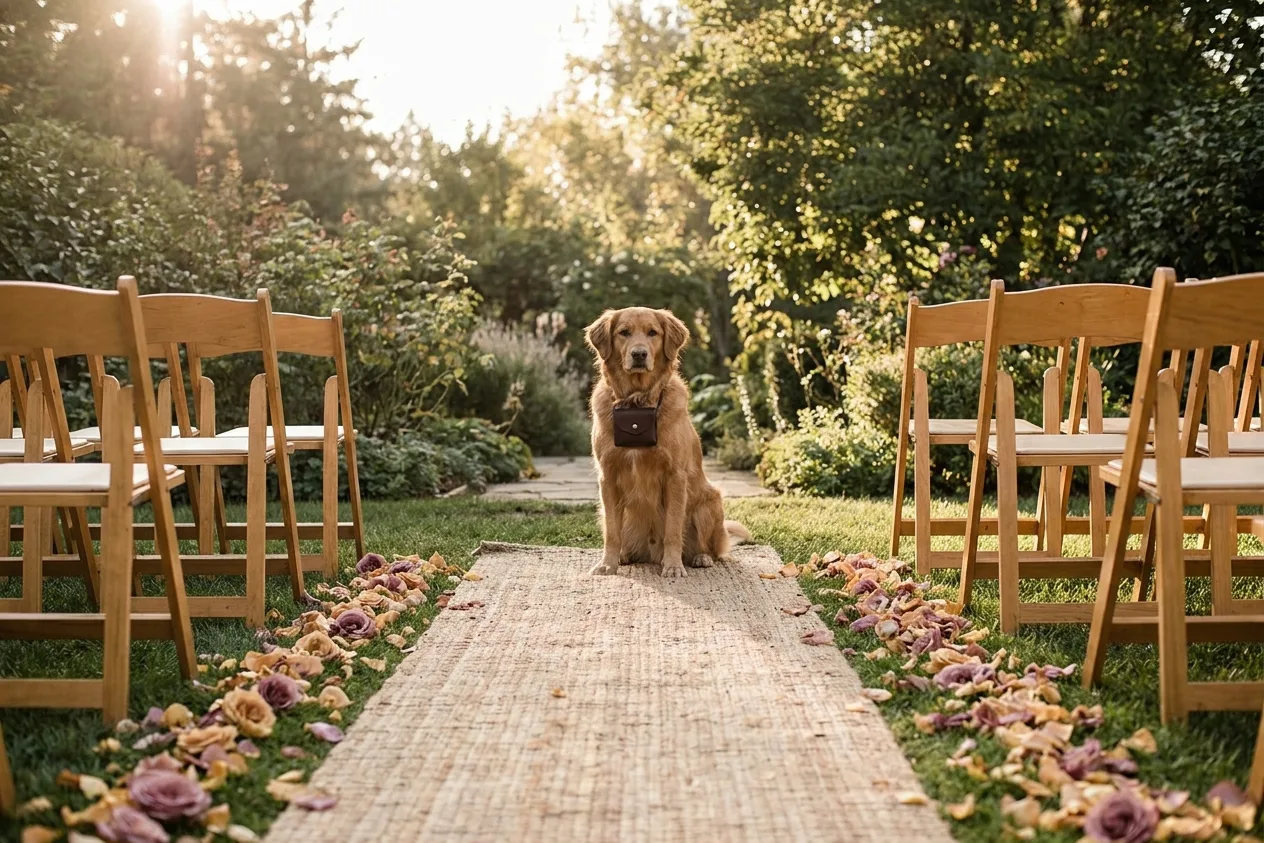
1–2 minThe real rings do not travel on the animal. A pouch on a collar can carry a stand-in pair for the photographs; the rings that go on fingers stay with a person whose only job is holding them.
May we have the rings, please.
[The rings are brought forward by [name]. If the pet is wearing a ring pouch, it holds a stand-in pair and nobody opens it during the ceremony.]
[Partner A], place the ring on [Partner B]’s finger and repeat after me.
I give you this ring as a sign of my love and of everything I promised today. Wear it, and know that I am yours.
And [Partner B], repeat after me.
I give you this ring as a sign of my love and of everything I promised today. Wear it, and know that I am yours.
Pronouncement
1 minLift your voice, and warn the handler in advance that the applause after the kiss is the loudest sound of the day. It is the moment a startled animal reacts.
[Partner A] and [Partner B], you have declared your intention in front of everyone here, made your promises, and sealed them with rings. And so, by the power vested in me by the [state / jurisdiction], it is my great joy to declare that you are married. You may kiss.
[The couple kisses, to applause. The officiant lets it crest.]
Recessional
1 minEnd high, name them the way they asked, and let the handler leave by the route you agreed. Somebody other than the couple takes the animal home, and that person was named days ago.
Friends and family, for the very first time, please welcome [the newly married couple, announced as they wish], and [Pet’s name], who is going home for a nap.
[The couple leads the way out. The handler follows with the pet and takes them straight to the agreed quiet place, with water and shade, then home with the named person.]
Officiant’s notes
The first question is whether to do it at all
Before anyone writes a pet wedding ceremony script, ask the honest question: will this animal enjoy the day? A wedding is a crowd of strangers in unfamiliar clothes, on an unfamiliar floor, with music, applause, and forty hands reaching down. A dog who is easy at the park may not be easy here, and a nervous, reactive, elderly, or unwell animal is being asked for something they cannot give. Most cats should stay home, and a photograph with the couple before or after is the kinder version of including them. Give the couple explicit permission to change their minds, because many of them want to and are waiting for someone to say it is allowed.
If the answer is yes, put it in writing with the venue: whether the animal may be indoors, on the lawn, in the ceremony space, and in photographs, and what happens in the rain plan. Ask the couple about allergies among the guests and about anyone who is frightened of dogs, and seat those people accordingly rather than hoping. Then appoint the handler by name, in advance, and say out loud what the job is: they hold the leash, they watch the animal rather than the ceremony, and they leave the moment the animal needs to leave without asking anybody’s permission.
What actually goes wrong
A dog in a wedding ceremony fails in a short list of predictable ways. The real rings ride on the collar and come off somewhere in the grass. The dog walks the aisle alone and runs to a familiar face in row three. Nobody plans a break, and the animal has been in a hot car or a warm room for two hours before anyone thinks about it. Somebody keeps treats in a pocket and the animal spends the vows staring at the officiant. Dark fur in full sun, hot pavement under paws, and a polished floor that a dog will not walk on are all avoidable, and all of them get discovered at the wrong moment.
So plan the small things. A potty break inside the hour before the processional, water at the seat, a leash that photographs well and is short enough to control, a break in the shade during photographs, and no treats on anybody who is not the handler. Warn the handler that the applause after the kiss is the loudest thing that will happen and is the likeliest startle point. Name the person who takes the animal home before the reception starts, and never, in any weather, leave them in a car. A pet who leaves happy is the version of this everyone wanted.
Keep the tone light without letting it tip
A ceremony with an animal in it is warmer and funnier than most, and the vows are where couples want that to show. If they would rather take something finished than write it, the funny wedding vow sets land a laugh and then turn serious in the last line, which is the shape that works here.
The one thing to hold is the tip point. One running joke about the dog is charming and three is a routine, and a ceremony that becomes a comedy set leaves the couple nothing to be moved by. Keep the humor inside the vows, and let the declaration and the pronouncement stay entirely straight.
Write and perform every ceremony from one desk
RiteBinder is the booking desk and the writing desk in one: interview the couple, draft and personalize the script, and read from a podium that needs no signal on the day. Free to start.
Frequently Asked Questions
- Can a dog be part of a wedding ceremony?
- Yes, with a plan. The parts that make it work are a handler who is not the couple and has no other job, the venue’s written permission, a planned moment early in the ceremony, and a planned exit right after it. The script on this page is built around exactly that shape, so the animal is included properly rather than hoped for.
- Should our dog carry the rings?
- Not the real ones. Rings come loose, collars turn, and grass keeps whatever it is given. If the couple loves the picture, put a stand-in pair in a pouch on the collar for the photographs and keep the real rings with a person whose only job is holding them. Nobody watching can tell the difference, and nothing gets lost.
- Who should walk the dog down the aisle?
- An adult who knows the animal well and has no other role in the ceremony. Not the couple, who are otherwise occupied, not a child, and not a member of the party who has to stand at the front. The animal walks beside that person on a leash, and that person sits at the end of a row near an exit for the rest of the ceremony.
- What about cats and other pets?
- Be realistic about the animal in front of you. Most cats are not made happier by a crowd, and a carrier at a wedding is rarely a good afternoon for anyone in it. A portrait with the couple before or after the day, or an empty-chair nod and a photograph on the seating table, includes them without asking them to endure something.
- When in the ceremony should the pet’s moment be?
- Early, and before the vows. An animal has a fixed amount of patience, and you want it spent on a block you could lose rather than on the one block you cannot. Give the moment under two minutes, then have the handler take them back to their seat on schedule rather than waiting to see how long they last.