A handfasting ceremony script
Runtime: 12–16 minutes as a full ceremony · 3–4 minutes as a ritual inside a larger wedding
Updated August 2026
Handfasting is one of the oldest wedding customs in the world: a ceremony in which the couple’s hands are gently bound together with cords or ribbons as they make their promises. It’s where the phrase “tying the knot” comes from, and its plain, physical symbolism still moves a room in a way words alone rarely do.
This is a complete handfasting script. You can perform it as an entire ceremony, or lift the binding ritual on its own and drop it into another wedding right where the vows would go. It narrates the cords as they’re placed so every guest understands what they’re watching, gives you the words to say as you bind the couple’s hands, and shows you how to leave them holding the knot they tied.
The ceremony, step by step
Gathering
1–2 minStand to the side. Wait for the room to settle before you speak.
[Guests are seated. The couple takes their place facing each other and the officiant, near whoever is holding the cords.]
Welcome and what handfasting is
2–3 minExplain the ritual up front so no guest is lost when the cords appear. Warm and clear. You’re narrating a tradition, not lecturing on it.
Welcome, everyone. Please, be seated.
[Partner A] and [Partner B] have chosen to be married with a handfasting — one of the oldest ways two people have ever joined their lives. Long before rings and registries, couples across many cultures bound their hands together with cord as they made their vows. It’s a simple, honest picture: two separate people choosing, with their own hands, to be tied to each other. It’s also where we get the phrase “tying the knot.”
Couples come to handfasting from different directions — some from the Celtic and pagan traditions where it has deep roots, some simply drawn to its beauty. However [Partner A] and [Partner B] arrived at it, in a few moments they’ll make their promises, and as they do, their hands will be bound together — and they’ll leave here still holding the knot they made.
Joining hands and the cords
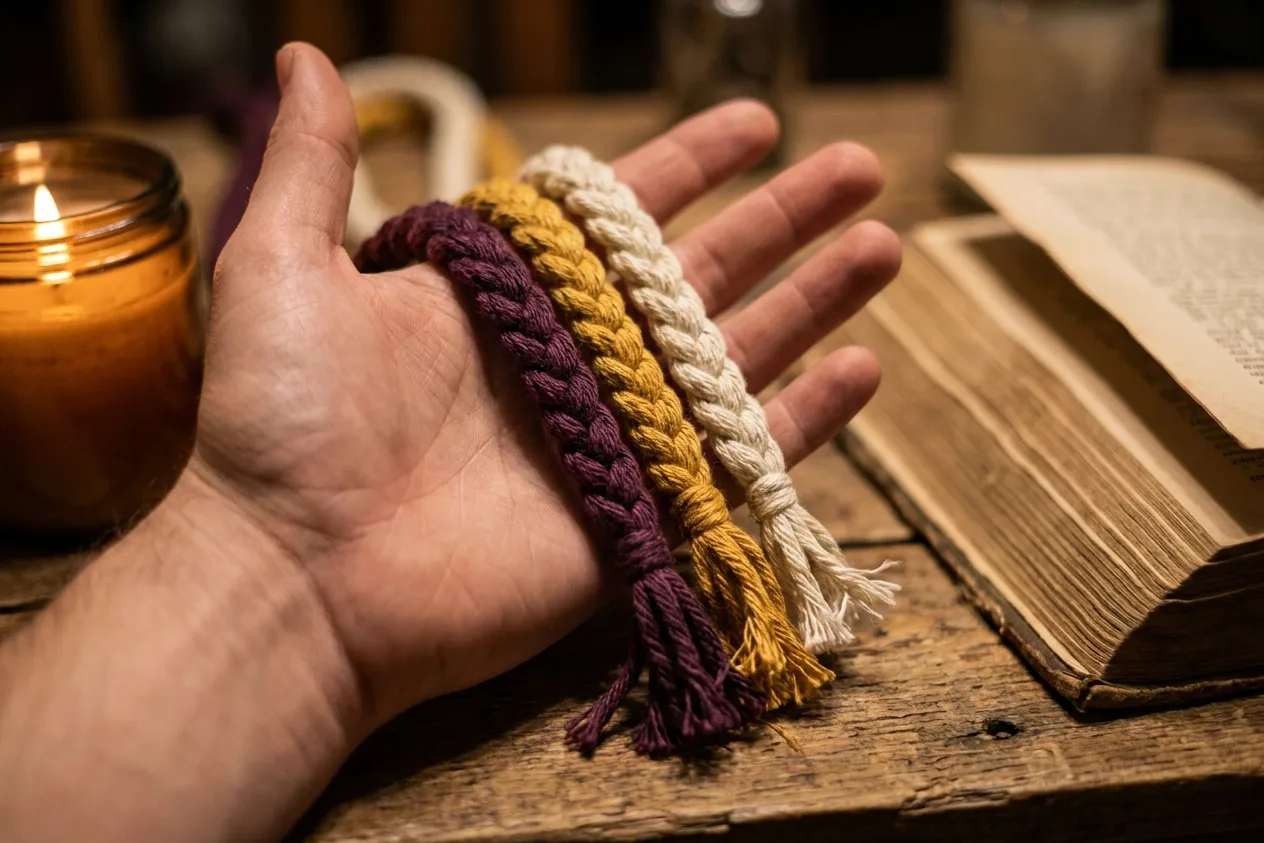
1–2 minPractical: have the cords chosen and to hand (often three, in colors the couple picked, sometimes given by family). Know who passes them to you and rehearse the drape once so nothing snags on the day.
[The person holding the cords brings them forward. The couple joins hands, traditionally right hand to right hand and left to left, so the arms cross and form a figure eight.]
[Partner A] and [Partner B], join your hands, and look at each other. These cords are given with love. As I wrap each one around your hands, I’ll name what it binds you to. Every one is easy to place and easy to slip free — because what holds you together isn’t the cord, but the promises you make while it rests on your wrists.
The binding
2–3 minDrape one cord at a time as you say its line, loosely; the couple slides free at the end. Ask the couple beforehand which promises they want named; the three below are a starting point.
With this first cord, I bind you to friendship. May you be, before anything else, kind to each other — and each other’s favorite company.
[The officiant loosely drapes the first cord across their joined hands.]
With this second cord, I bind you to honesty and to patience. May you tell each other the truth gently, and give each other room to grow, to fail, and to try again.
[The second cord is laid over the first.]
And with this third cord, I bind you to joy and endurance. May you laugh often and easily, and hold fast to each other through whatever weather the years bring.
[The third cord is added. The couple’s joined hands now rest within the loosely gathered cords.]
The vows over bound hands
2 minThis is the heart of it: bound hands, watching people. Slow down. Lead each partner a phrase at a time.
Now, with your hands bound and your people watching, make your promises. [Partner A], repeat after me.
I bind myself to you, [Partner B], of my own free will. I promise you my friendship, my honesty, and my whole heart, for as long as I live. These are the ties I gladly choose.
And [Partner B], repeat after me.
I bind myself to you, [Partner A], of my own free will. I promise you my friendship, my honesty, and my whole heart, for as long as I live. These are the ties I gladly choose.
Tying the knot
1–2 minIf a family member ties it, cue them now. [Pause; work slowly and narrate.]
[The officiant, or a chosen family member, gently gathers the cords and ties them into a single knot as the couple holds still.]
The knot is tied — not by the cord, but by your own words. [Partner A] and [Partner B], you came here as two, and with your own hands and your own promises you’ve bound your lives together.
Slipping free and keeping the knot
1 minExplain this so no one worries the couple is stuck: the cords come off, and they keep the tied knot as a keepsake. Reassure with a light touch.
[The couple gently slides their hands free of the cords, and the officiant sets the tied knot aside for them to keep.]
Slip your hands free now, and keep this knot. The cords come off easily — as they should, because you were never really held together by anything so simple as a rope. You’re held by what you promised. Put this knot somewhere you’ll see it, and remember the day you tied it.
Pronouncement
1 minLift your voice. If there are rings, exchange them just before this. Pause after “married” for the kiss.
[If the couple is exchanging rings, they do so now, before the pronouncement.]
[Partner A] and [Partner B], you’ve bound your hands and spoken your promises in front of all of us. And so, by the power vested in me by the [state / jurisdiction], it is my joy to declare you married. You may kiss.
[The couple kisses, to applause.]
Recessional
1 minName them as they asked, and step back.
For the first time, everyone — [the newly married couple, announced as they wish].
[The couple leads the recessional, the party behind, the officiant last.]
Officiant’s notes
Handling the cords so the ritual lands
A handfasting lives or dies on the logistics, so rehearse the physical part before the day. Decide how many cords you’ll use and what each one means, in the couple’s own words if they have preferences; three is common, but one is plenty. Practice the drape and the tie once with real cord, loosely, so the couple can slide free at the end without a struggle, and know exactly who hands you the cords and when. A knot that snags, or a cord pulled too tight, is the one thing that turns a beautiful moment awkward.
Keep the couple’s hands the focus. Position yourself slightly to the side, work slowly, and narrate what you’re doing as you go. The script above says each line out loud precisely so no guest is left wondering what’s happening. The image of two bound hands is doing the emotional work; your job is to stay out of its way and let it be seen. Mind your microphone here too: you’ll be looking down at your hands, so clip the mic or have it on a stand rather than holding it, and keep projecting even while you concentrate on the cords.
Respect the tradition, fit the couple
Handfasting has deep roots in Celtic and pagan practice and belongs to living traditions today, so wear that lightly and honestly. If the couple comes to it from those traditions, honor their specifics; if they simply love the symbolism, say so plainly rather than inventing a lineage that isn’t theirs. Either way, let the couple choose what the cords stand for and what the words say — the ritual is old, but this marriage is theirs.
The promises spoken over the bound hands are the part couples most often want in their own words, and the binding gives you a natural moment to hand over. If they want something finished rather than written from scratch, the secular vow sets suit this ritual well: they invoke no faith, which keeps the ceremony as the couple chose it, and they are short enough to say comfortably while their hands are tied.
You can perform this as a whole ceremony or set just the binding inside a longer wedding, right where the vows sit: run your usual welcome and address, insert the cords and the binding here, then carry on to the rings and the pronouncement. Confirm names and pronunciations as carefully as for any ceremony, and read it aloud once, timed, so the pacing of the binding feels calm rather than fussy on the day.
Write and perform every ceremony from one desk
RiteBinder is the booking desk and the writing desk in one: interview the couple, draft and personalize the script, and read from a podium that needs no signal on the day. Free to start.
Frequently Asked Questions
- What is a handfasting ceremony?
- Handfasting is an old wedding ritual in which the couple’s hands are tied together with cords or ribbons while they make their vows, the origin of the phrase “tying the knot.” It has roots in Celtic and pagan traditions and is used today by couples of many backgrounds, religious and secular. This script gives you the full ritual, the words to say, and the practical steps.
- How many cords do I need, and what do they mean?
- There’s no fixed rule. Many handfastings use three cords, often in colors the couple chooses or that family members give, with each standing for a promise: friendship, honesty, joy, and so on. One cord works just as well. Let the couple decide the number, the colors, and the meanings; this script names three you can keep or replace.
- Do the couple stay tied together for the rest of the ceremony?
- No. The cords are draped and knotted loosely, and after the binding the couple gently slides their hands free, keeping the tied knot as a keepsake. The meaning is in the promise made while bound, not in staying literally attached; the script reassures guests of this so no one worries the couple is stuck.
- Can I add handfasting to a regular wedding?
- Yes, easily. The binding ritual drops neatly into a larger ceremony right where the vows sit: perform the welcome and address from your main script, insert the cords and binding here, then continue to the rings and pronouncement. See the complete wedding ceremony script for the surrounding wording.
- Is handfasting legally binding on its own?
- The ritual itself carries no legal weight; what makes the marriage legal is a valid license and an authorized officiant who signs and returns it. Handfasting is the ceremonial heart. Pair it with the legal declaration of intent and the paperwork, and confirm the license requirements with the county clerk.