Religious wedding vows
Updated August 2026
Religious vows are the ones a family is most likely to have opinions about, so this page is careful about where its words come from. Two of the sets below are the historic English rite reproduced exactly, with its source named. The others are our own wording, built on the same traditional shape, for couples who want a faith-centered promise in language a modern room hears clearly.
What you will not find here is a modern denominational rite. Contemporary Catholic, Latter-day Saint, Orthodox and Reform or Conservative Jewish marriage services are recent texts that belong to the communities that publish them, and reprinting one as a free template would be both a copyright problem and a misrepresentation of what it is. If you are marrying inside one of those traditions, your officiant has the authorized wording, and that is the wording your family expects.
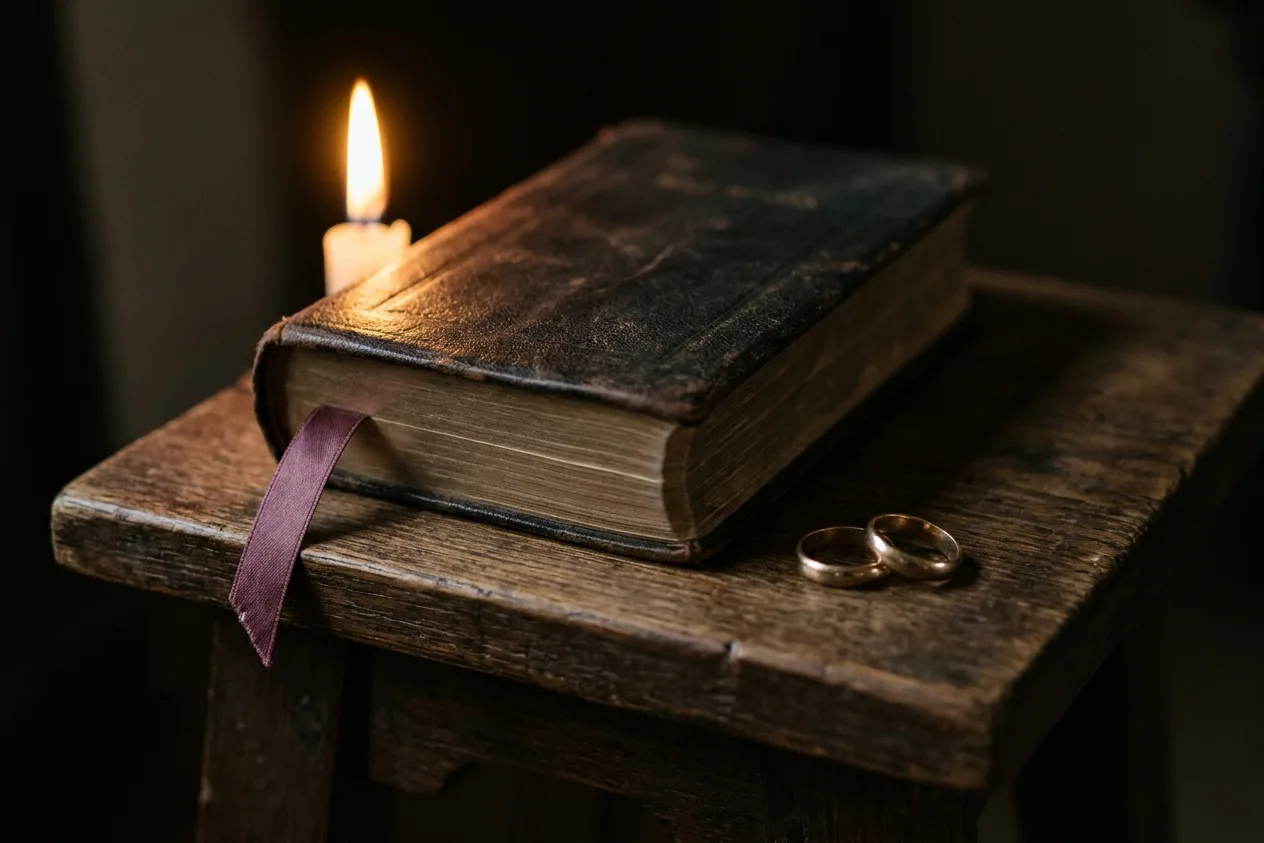
Complete sets, ready to say
The traditional English vow
about 25 seconds eachThe source of almost every English-language wedding vow you have ever heard. Suits a formal, traditional service, and any couple who wants the historic words rather than an imitation of them.
Where these words come from
The Church of England, The Form of Solemnization of Matrimony, The Book of Common Prayer, first published 1662. The 1662 Book of Common Prayer is in the public domain in the United States, and these are its own words rather than a modern rewriting of them. In the United Kingdom the book sits under a perpetual Crown letters patent, which affects publishing rather than saying it aloud.
Checked against The Church of England’s published text, described there as "The Form of Solemnization of Matrimony, from The Book of Common Prayer (1662)".
One partner says
I [Partner A] take thee [Partner B] to my wedded wife, to have and to hold from this day forward, for better for worse, for richer for poorer, in sickness and in health, to love and to cherish, till death us do part, according to God’s holy ordinance; and thereto I plight thee my troth.
The other says
I [Partner B] take thee [Partner A] to my wedded husband, to have and to hold from this day forward, for better for worse, for richer for poorer, in sickness and in health, to love, cherish, and to obey, till death us do part, according to God’s holy ordinance; and thereto I give thee my troth.
This is the 1662 text exactly as it stands, including "to obey" in the second vow, which most couples today replace with "to love and to cherish" so both promises match. Changing it is entirely normal; pretending the original did not say it is not.
The traditional ring words
about 10 seconds eachSaid as each ring goes on, in the same historic service. Pairs with the vow above, and works just as well attached to a modern vow.
Where these words come from
The Church of England, The Form of Solemnization of Matrimony, The Book of Common Prayer, first published 1662. The 1662 Book of Common Prayer is in the public domain in the United States, and these are its own words rather than a modern rewriting of them. In the United Kingdom the book sits under a perpetual Crown letters patent, which affects publishing rather than saying it aloud.
Checked against The Church of England’s published text, described there as "The Form of Solemnization of Matrimony, from The Book of Common Prayer (1662)".
One partner says
With this ring I thee wed, with my body I thee worship, and with all my worldly goods I thee endow: In the Name of the Father, and of the Son, and of the Holy Ghost. Amen.
The other partner says the same words, with the names swapped.
In the 1662 service only one ring was given. Couples exchanging two rings simply say it twice, and many shorten it to the first clause.
A faith-centered vow, in modern English
about 35 seconds eachOur own wording on the traditional shape, for a service that is unmistakably religious but does not require a set liturgy. Suits an outdoor or independent ceremony.
One partner says
[Partner B], before God and in front of everyone we love, I take you to be my [wife / husband / partner].
I promise to love you and to honor you, for better and for worse, for richer and for poorer, in sickness and in health, and to keep faith with you alone, for as long as we both shall live.
I make this promise freely, and I ask God to help me keep it.
The other partner says the same words, with the names swapped.
This is our wording, not a rite. If your service belongs to a tradition with a required form, use theirs; this is for ceremonies that do not have one.
A prayerful promise
about 40 seconds eachGentler and more personal, for couples whose faith is central but who find formal liturgical language stiff to say out loud.
One partner says
[Partner B], I believe we were brought here on purpose, and I am not taking that lightly.
I promise to love you as I have been loved: patiently, and without keeping score. I promise to forgive you quickly, to tell you the truth gently, and to pray for you on the days I do not know what else to do.
For better and for worse, for as long as I live, I am yours. And with God’s help, I will keep this promise.
The other partner says the same words, with the names swapped.
Notes on saying these well
Where these words come from, and why it matters
The vow most English-speaking people think of as "the traditional one" is traceable to a specific book: the Book of Common Prayer, whose 1662 edition fixed the wording that spread through churches, courthouses, and eventually films. That book is public domain in the United States, which is why its exact words can be printed here in full, with the source named under them.
That is not true of the rite your own church, temple or congregation uses today. Modern services are recent works with living publishers, and they are also the versions your family will recognize. So use this page to choose a shape and to understand what the promises are doing, and get the exact wording of a denominational service from the people who officiate it.
Ask before you assume the wording is yours to choose
A civil ceremony leaves the vow almost entirely up to the couple. A religious service very often does not. Many houses of worship require a set form, some allow the couple to add personal vows after the required ones, and a few permit no substitution at all. This is the single most common late surprise in religious weddings, and it is a five-minute conversation to avoid.
Ask three things early: whether the vow wording is fixed, whether personal vows may be added and where they would sit, and whether the ring words are part of the required service. Then write to fit the answer rather than writing first and negotiating later.
Write and perform every ceremony from one desk
RiteBinder is the booking desk and the writing desk in one: interview the couple, shape the script and the vows, and read from a podium that needs no signal on the day. Free to start.
Frequently Asked Questions
- What are the traditional Christian wedding vows?
- The best-known English form comes from the 1662 Book of Common Prayer, and it is reproduced in full on this page with its source stated: to have and to hold from this day forward, for better for worse, for richer for poorer, in sickness and in health, till death us do part. Modern services rephrase it, and each denomination has its own authorized version.
- Do we have to say "to obey"?
- No. The 1662 text has it in one of the two vows and not the other, and most couples today either drop it or replace it so that both promises match. Any officiant will expect that request; it is one of the most common changes made to the historic wording.
- Why are our own tradition’s vows not printed here?
- Because modern denominational rites are still in copyright and belong to the communities that publish them. Reprinting one as a free template would be both unlawful and misleading. Your officiant has the authorized text, and it is the version your family will recognize.
- Can we add personal vows to a religious ceremony?
- Often yes, usually after the required promises rather than instead of them. Ask early, because the answer varies by tradition and by individual officiant, and it changes what you should write.
- Is the 1662 wording free to use?
- In the United States, yes: the 1662 Book of Common Prayer is in the public domain there, which is why its words appear here in full. In the United Kingdom it sits under a perpetual Crown letters patent, which affects printing it rather than saying it aloud.