Wedding ceremony outline: the 9 blocks
Updated August 2026
Almost every wedding ceremony is built from the same nine blocks, arranged and trimmed to fit the couple. Learn the blocks and you can build a ceremony for anyone (religious or secular, ten minutes or thirty) without ever staring at a blank page.
Here is each block, in the usual order, with what it is for and roughly how long it runs. Treat it as a menu, not a mandate: cut what does not fit, reorder freely, and add a ritual where the couple wants one.
Blocks 1–3: gather the room
Block one is the processional and the welcome. The party walks in, and you greet everyone and name why they are here. Keep it warm and brief (thirty seconds to a minute). This is where the room settles and turns toward the couple.
Block two is the opening words: a short reflection on marriage, on love, or on this specific couple. Block three is any readings: a poem, a passage, a few words from a friend. One or two readings is plenty; three starts to sag. Together these set the tone before the vows.
Block three is also the one couples most often leave until last, and the one where a wrong choice is most obvious in the room. Our wedding readings library prints every text in full with the year it was published and the reason it is free to use, which settles the two questions that stall this block: what to read, and whether it can go in the printed program.
Blocks 4–6: the heart
Block four is the declaration of intent: the classic "do you take…" The couple says "I do," and the room exhales. It is short and load-bearing; do not clutter it.
Block five is the vows, the emotional center of the whole ceremony, whether the couple wrote their own or repeat traditional lines. Block six is the ring exchange, with a line or two on what the rings mean. These three blocks are the reason everyone is standing there, so give them room and do not rush.
If the couple has not decided which of those two block five is, decide it early rather than on the day: the wedding vows library carries complete sets by tone alongside the method for writing your own, so a couple can read a few aloud and find out which they actually want before you build the rest of the ceremony around it.
Blocks 7–9: seal it and send them out
Block seven is an optional unity ritual: a handfasting, a candle, a sand ceremony, a blessing from family. Use it when it means something to the couple and skip it when it would just pad the runtime.
Block eight is the pronouncement (the moment you declare them married), followed immediately by the kiss. Block nine is the recessional: a closing line, an introduction of the newly married couple, and the walk back up the aisle. End on a high note and get out of the way. The party is waiting.
How long should the whole thing run?
Add up the block times and most ceremonies land between fifteen and twenty-five minutes, and that is the sweet spot. Shorter can feel rushed for a wedding; much longer and even a warm crowd starts shifting in their seats. Guests remember how a ceremony felt, and length is a big part of that feeling.
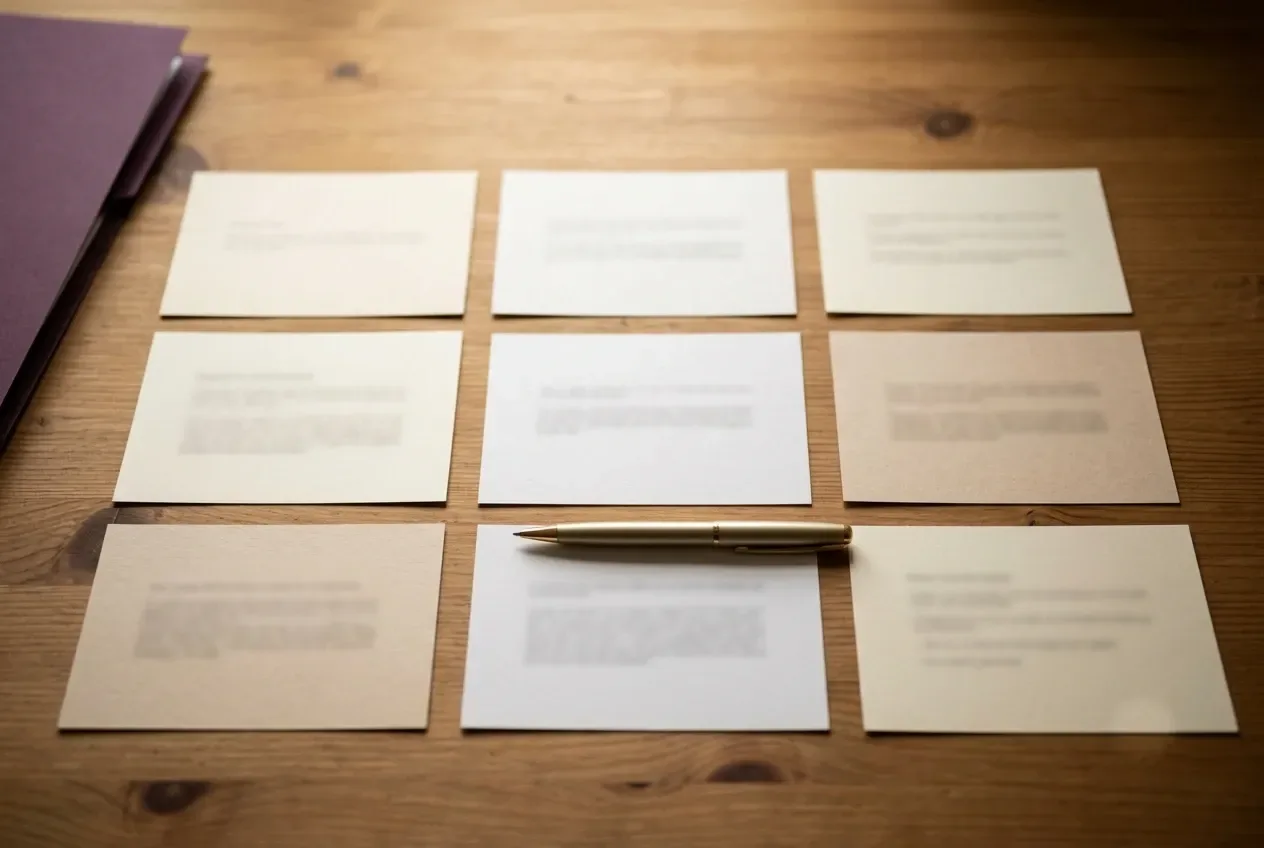
The levers are the optional blocks. Two readings instead of one, a unity ritual, a longer set of vows — each adds real minutes. Decide the runtime you want first, then choose how many optional blocks fit inside it, rather than writing everything and discovering on the day that you are running long. If you like a visual, sketch the order and watch the minutes add up before you commit.
Adapting the outline to other ceremonies
The same instinct — gather, build to a center, seal, and send out — carries to other rites. A vow renewal keeps the vows and the pronouncement but trades the declaration for reflection on the years already shared. A naming replaces the vows with promises to a child. A memorial keeps the welcome, the readings, and the send-off, in a far quieter register, with the tribute where the vows would sit.
It also survives being doubled. Where two families bring different faiths, the interfaith ceremony script runs the same nine blocks with two blessings written into the structure rather than one bolted on at the end; where two languages are in the room, the bilingual ceremony script shows which blocks are worth saying twice and which only need a summary. In both cases the outline is what keeps the ceremony from running to forty minutes.
Once the nine blocks are second nature, you stop building ceremonies from scratch and start assembling them from parts you trust. Save your best versions of each block in a library and reuse them, adjusting the specifics for the people in front of you. Over time you build a personal kit (a welcome that always lands, a favorite blessing, a ring-exchange line you have refined), and every new ceremony starts from strength instead of a blank page.
Borrowing is a fine way to start that kit. Every ceremony in our library of complete ceremony scripts is laid out on these nine blocks and written out in full, so you can lift a welcome you like from one, a ring-exchange line from another, and a handfasting or a five-minute pronouncement from a third, then make each one sound like you.
Do the whole job in one place
RiteBinder is the booking desk and the writing desk in one: the interview, the script, the readings, and a podium that needs no signal on the day. Free to start.