An interfaith wedding ceremony script
Runtime: 20–25 minutes
Updated August 2026
This is a complete interfaith wedding ceremony: every word, with two full blessings written into the structure rather than added at the end. It is built for a couple whose families come from different faiths and who want both of them present at full volume, in their own words, given by people who carry them honestly.
The officiant’s job here is to be the host of the room. You introduce each tradition plainly so no guest is lost, you give each one the same space and the same silence, and you stay out of the way while it happens. Replace the bracketed names and traditions, agree the order with both families, and the ceremony is ready to perform.
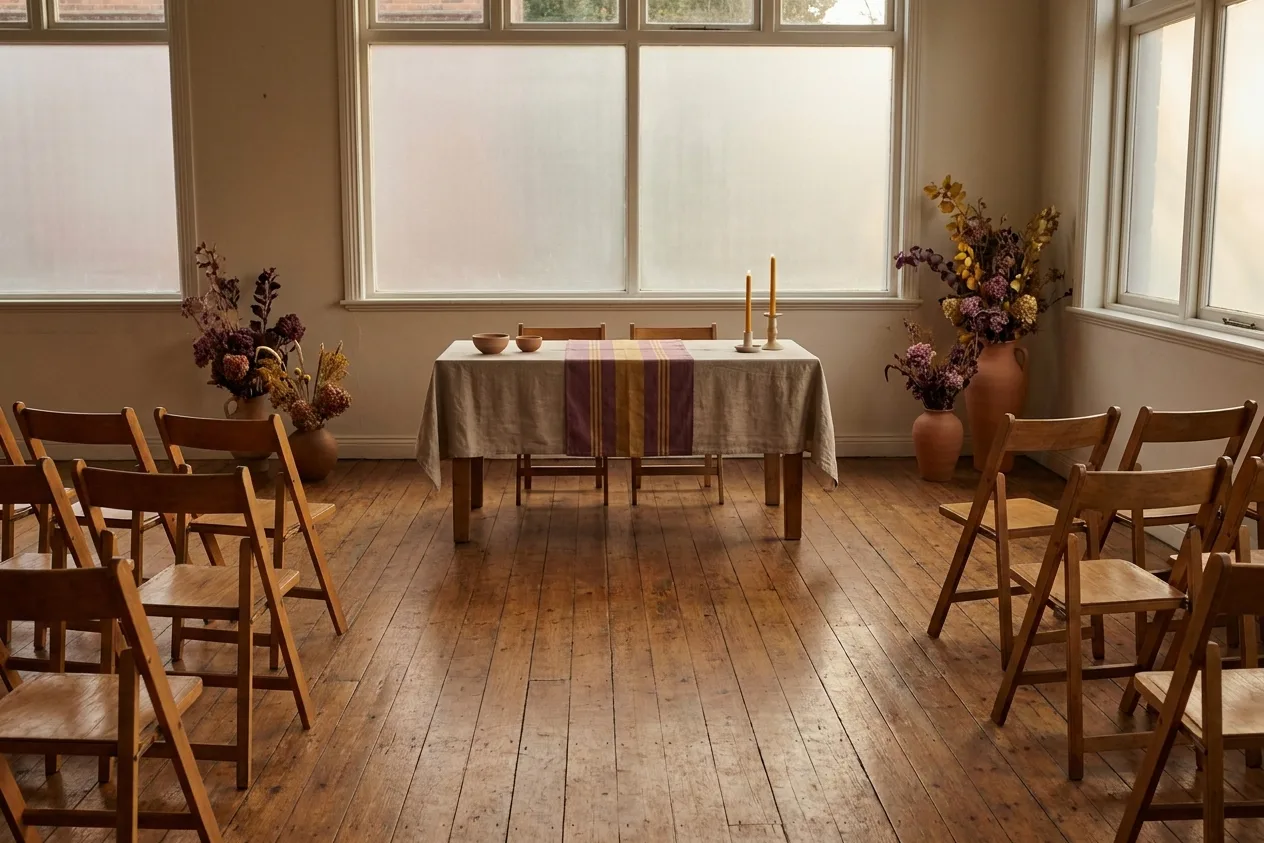
The ceremony, step by step
Processional
2–3 minTwo families are watching each other as much as they are watching the couple. Stand where both sides of the room can see you, and let the music finish before you speak.
[Guests are seated. If the families are seated formally, both sets of parents are escorted in first. The wedding party enters, then the couple.]
Welcome
2 minGreet the whole room as one gathering before you name anything that distinguishes its halves. Check your microphone on the first sentence.
Good evening, everyone, and welcome. Please, be seated.
We are here for the marriage of [Partner A] and [Partner B]. Take a look around this room for a moment. Two families are in it, from two traditions, each with a long history of doing this day its own way. Today those families become one, and every person here is part of that.
Nothing in this ceremony asks anyone to set aside what they believe. It asks something simpler and harder: that we stay in this room together, generous toward whatever is unfamiliar, while two people we love make their promises.
Two traditions, both of them whole
2–3 minSay plainly what the couple has chosen and why. Do not apologize for the mix, and do not flatten it. Use the exact names of both traditions and write their pronunciations into your copy.
[Partner A] was raised in [tradition A]. [Partner B] was raised in [tradition B]. They did not choose between them, and they are not asking any of us to. What they built instead is a ceremony where each tradition speaks in its own voice, at its own length, in its own words.
That is not a compromise. It is an honest description of the household they are about to keep, which will hold two sets of holidays, two grandmothers with firm opinions about food, and two ways of marking the days that matter. A marriage roomy enough for both is a real achievement, and you are about to watch one get built.
So you will hear two blessings today, from two people who carry these traditions faithfully. Some of what you hear will be familiar to you. Some of it will not. Both of them belong here.
The first blessing
2–3 minIntroduce the person by name and by their relationship to the couple, then step back and let them work. Agree the length weeks in advance. Never narrate over a blessing.
[Partner A]’s family brings the first of today’s blessings. [Name] will offer it in the words and the language of [tradition A].
[[Name] comes forward and gives the blessing, prayer, reading, or short ritual of that tradition, in their own words. The officiant steps aside and stays silent throughout.]
Thank you, [Name].
The second blessing
2–3 minGive this one the same introduction, the same length, and the same silence you gave the first. Guests keep score without meaning to, and any imbalance here is what a family remembers.
And [Partner B]’s family brings the second. [Name] will offer it in the words and the language of [tradition B].
[The second blessing is given, in the same shape and roughly the same length as the first. The officiant steps aside again.]
Thank you, [Name].
Two blessings, two traditions, one marriage. [Partner A] and [Partner B], your families have just said, in their own oldest words, that they want good things for you.
Declaration of intent
1 minKeep this block belonging to neither tradition. It is the plain legal question, asked the same way of each partner, and the room hears the symmetry.
[Partner A], do you take [Partner B] to be your [wife / husband / partner], to honor what they believe and where they come from, to stand with them in good seasons and hard ones, and to choose this marriage for the rest of your life?
[Partner A]: I do.
And [Partner B], do you take [Partner A] to be your [wife / husband / partner], to honor what they believe and where they come from, to stand with them in good seasons and hard ones, and to choose this marriage for the rest of your life?
[Partner B]: I do.
The vows
2–3 minSlow right down. After two blessings the room is full of borrowed language, and these are the first words that belong only to the couple.
Please face each other and join hands. [Partner A], repeat after me.
I, [Partner A], take you, [Partner B], to be my [wife / husband / partner]. I will keep our home open to both of the families that made us. I will learn what you hold sacred and treat it gently, tell you the truth, and stand beside you in whatever comes. From today, whatever else I am, I am yours.
And [Partner B], repeat after me.
I, [Partner B], take you, [Partner A], to be my [wife / husband / partner]. I will keep our home open to both of the families that made us. I will learn what you hold sacred and treat it gently, tell you the truth, and stand beside you in whatever comes. From today, whatever else I am, I am yours.
The rings
1–2 minKnow who is holding the rings. Keep the ring words neutral, since both traditions have just had their say. [Pause for each ring to go on.]
May we have the rings, please.
A ring says the same thing in every language anyone here grew up speaking: this person is spoken for, gladly, and the promise is meant to outlast the day it was made.
[Partner A], place the ring on [Partner B]’s finger and repeat after me.
I give you this ring as a sign of my love and of everything I promised today. Wear it, and know that I am yours.
And [Partner B], repeat after me.
I give you this ring as a sign of my love and of everything I promised today. Wear it, and know that I am yours.
A shared ritual
2 minOptional, and often the most moving block on an interfaith day, because it belongs to neither family and therefore to both. Explain what it is before it starts.
[If the couple has chosen a shared ritual of their own, it happens here.]
The blessings you heard came from where [Partner A] and [Partner B] each came from. This next thing belongs to where they are going, and it is theirs alone.
Pronouncement
1 minLift your voice. Name the legal authority plainly, because it is the one authority in the room that belongs to neither tradition. Pause before the kiss.
[Partner A] and [Partner B], you have been blessed twice, declared your intention in front of two families, and made your promises to each other. And so, by the power vested in me by the [state / jurisdiction], it is my great joy to declare that you are married.
Please, kiss.
[The couple kisses. The officiant waits for the applause to crest.]
Recessional
1 minIntroduce them exactly as they asked to be named, and name the families too if the couple wants that. Then get out of the way.
Friends and family, two families and now one: please welcome, for the very first time, [the newly married couple, announced as they wish].
[The couple leads the recessional, the wedding party behind them, the officiant last.]
Officiant’s notes
Balance is structural, not decorative
The failure mode of an interfaith wedding ceremony script is a ceremony that is really one tradition with a gesture toward the other near the end. Guests notice, and the family that got the gesture notices first. Build the balance into the structure instead: equal placement, equal length, equal introduction, and equal silence around each element. If one tradition gets a five-minute blessing from its own clergy, the other gets five minutes and its own voice too. If a couple wants an uneven ceremony, that is a decision they should make out loud in the planning, never one you make quietly by writing the script that way.
Get the language right before you worry about the prose. Learn the correct name of both traditions and of every element you introduce, write the pronunciations phonetically into your copy, and check them with each family rather than with a search engine. Ask each side what its element means so you can introduce it in one accurate sentence, and never present a tradition as the unusual one. You are the host of the room, and the room takes its cue about what counts as normal from the way you say it.
Two celebrants, two families, one rehearsal
Ask early whether each family expects its own clergy or celebrant, and whether that person is permitted by their own community to take part in a joint ceremony. Some are and some are not, and someone who declines is not being difficult. Where a co-officiant cannot share the ceremony, the common solutions are a separate blessing before or after, or a family member offering the tradition’s words instead. Raise it months out, in writing, and settle who holds legal authority to solemnize in that state so the license is signed by someone who actually can.
Then run the whole thing as one rehearsed sequence. Agree the order, the length of each element, who speaks when, and who hands over the microphone, and write every name on your page in the order you will need it. On the day, stand where both halves of the room can see you, keep your own sections short so the two blessings stay the largest things in the ceremony, and read the script aloud once, timed. It usually runs twenty to twenty-five minutes, and it feels far longer to a guest who cannot follow what is happening, which is why the plain one-line introductions matter more here than anywhere else.
Write and perform every ceremony from one desk
RiteBinder is the booking desk and the writing desk in one: interview the couple, draft and personalize the script, and read from a podium that needs no signal on the day. Free to start.
Frequently Asked Questions
- How do you write a wedding ceremony that honors two religions?
- Give each tradition its own moment, of the same length, introduced the same way, and let someone who carries that tradition speak its words rather than paraphrasing them yourself. Keep the officiant’s own sections neutral and short so neither faith is filtered through the other. The structure above does exactly that: welcome, a plain explanation, two full blessings, then vows and rings that belong to the couple alone.
- Do we need two officiants for an interfaith wedding?
- No. Many interfaith ceremonies use one officiant who introduces both traditions and invites a family member or a guest celebrant to give each blessing. Two celebrants can be lovely when both families want their own, but it takes more rehearsal and a clear agreement on who does what. Whichever you choose, only the person with legal authority in that state signs the license.
- What if one family’s clergy will not take part?
- It happens, and it is usually about that community’s own rules rather than about the couple. Ask early and in writing, so nobody is surprised in the last month. The usual solutions are a separate blessing held before or after the wedding, or a family member offering the tradition’s words inside the ceremony. Either way, keep the two halves balanced in the ceremony you do hold.
- Which tradition should go first?
- There is no rule, so make it a conversation rather than a coin toss. Couples often let the order follow something practical: whose celebrant has to leave early, which element runs longer, or which one flows better into the vows. Say the reason out loud to both families during planning and the order stops carrying any meaning it was never meant to carry.
- Is an interfaith ceremony legally valid?
- The religious content of a ceremony has no bearing on its legal validity. What makes the marriage legal is a valid marriage license and an officiant authorized to solemnize it in that place, who signs and returns the license correctly and on time. Confirm the requirements with the county clerk who issued the license, since they vary from state to state.