Unity ceremony scripts: candle, sand, wine box, and tree
Runtime: Four rituals of 3–4 minutes each, plus a 10-minute ceremony frame
Updated August 2026
Four unity rituals, each written out in full: the unity candle, the sand ceremony, the wine box with letters, and planting a tree. Every one gives you the setup, the words to introduce it so no guest is left guessing, the words to say while it happens, and the officiant’s notes on the way that particular ritual goes wrong.
The fifth script on this page is a short, complete ceremony frame with a marked slot to drop any of the four into, so you can perform the whole wedding from this page if you want to. Choose one ritual, not two. A ceremony with a single well-explained ritual feels considered; a ceremony with three feels like a craft fair.
The unity candle
about 3 minutesTwo flames lit separately, one candle lit together. The oldest of the unity rituals, and the one with the most decisions hiding inside it.
Setting up
before the ceremonyLight the tapers before guests arrive, or have two family members light them during the seating. Use a lighter rather than matches, keep a spare within reach, and outdoors use hurricane glass or do not use candles at all.
[Two taper candles stand lit on a small table, with one larger unlit candle between them. The table is set to the side, at a height that keeps it out of the couple’s faces in photographs, and nothing flammable is near it.]
Introducing the candle
1 minExplain it before anything is picked up. A guest who does not know what they are watching spends the whole ritual working it out instead of feeling it.
Before [Partner A] and [Partner B] make their promises, they are going to light a candle together. The two small flames were lit by [names], one from each family, and they have been burning since before any of us sat down. The large candle between them has never been lit.
In a moment they will each take one flame and bring it to the same wick. It is a small thing to watch and a large thing to mean: two lives, lit separately and long before they met, agreeing to make one light between them that neither could make alone.
The lighting
1 minStop talking while they do it. Stand where you are not between the candle and the camera, and do not reach in to help unless a flame actually goes out.
[Partner A], [Partner B], take up your candles and light this one together.
[Each partner lifts a taper, and together they light the center candle. The officiant stays silent until the flame is steady.]
Closing the ritual
30 secDecide with the couple in advance whether the two tapers stay lit or are put out, and use the matching line. Many couples dislike the extinguished version, so ask rather than assuming.
[If the tapers stay lit: Notice that the two small flames are still burning. Nobody disappears into a marriage. You are each still yourselves, and now there is a third light in the world that exists only because you are together.]
[If the tapers are put out: They will set their candles down now. From today there is one household, one light, and one story being told by two people.]
[The couple returns to their places and the ceremony continues.]
The sand ceremony
about 3 minutesTwo colors poured into one vessel, permanently mixed. The ritual that works outdoors, works in wind, and works with children.
Setting up
before the ceremonyThe receiving vessel needs a wider mouth than looks necessary, and the pouring jars need to be light enough to hold steady with one hand. Fill them only two-thirds full, and put a cloth under everything.
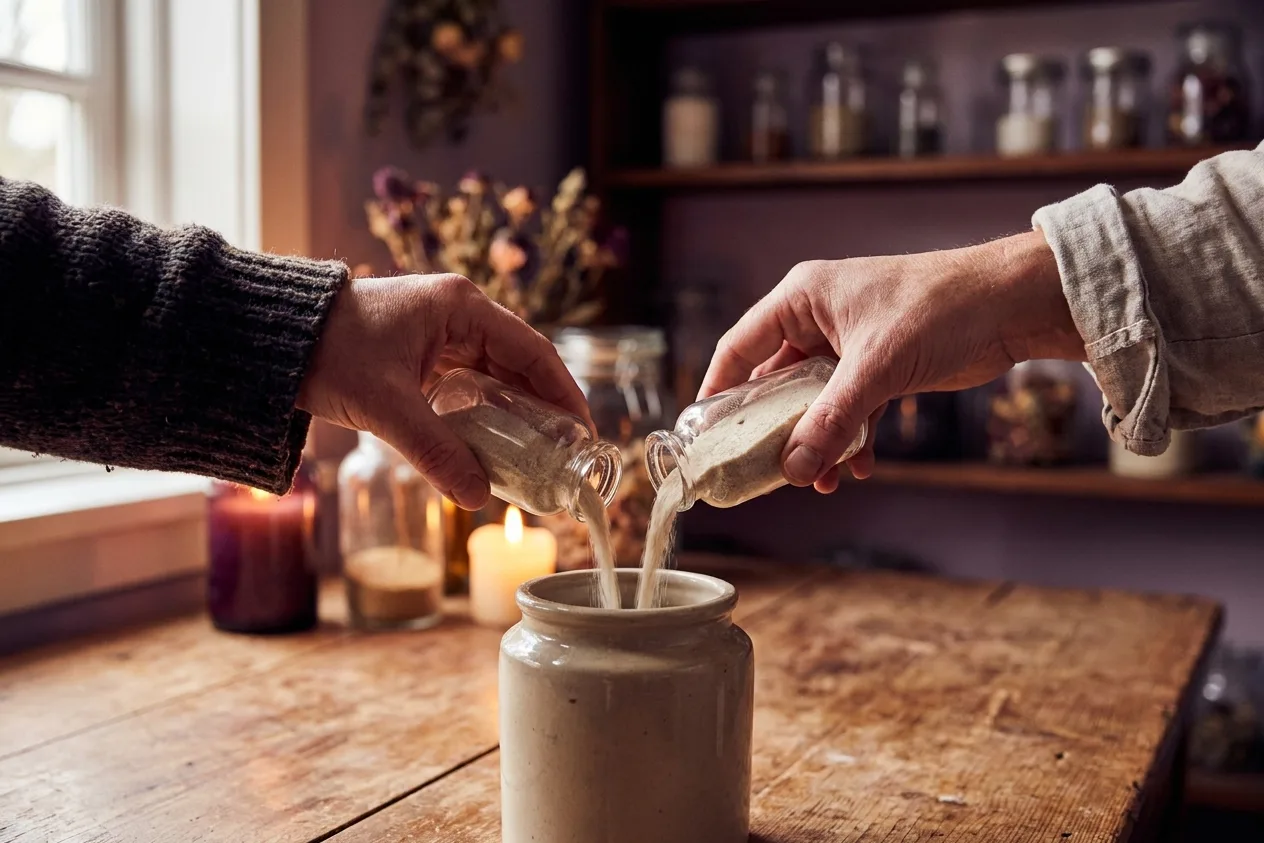
[A clear vessel stands on a small table, with one jar of colored sand for each person taking part. A lid or stopper is on the table beside it, and a cloth is underneath to catch what spills.]
Introducing the sand
1 minThis is the ritual that explains itself fastest, so keep the introduction short and let the pouring be the thing everyone watches.
[Partner A] and [Partner B] have each brought a color. In a moment they will pour them into the same vessel, at the same time, and from then on nobody on earth can separate them again. That is a stronger promise than anything I could say on their behalf.
The pouring
1–2 minTwo streams at once, poured slowly. Say each person’s name as they begin so the guests know who is pouring which color, and let the layers build rather than rushing them together.
[Partner A] and [Partner B], pour together, and take your time.
[The couple pours simultaneously, slowly, into the shared vessel. The officiant is silent throughout.]
[If there are children pouring: And this is not only about two people. [Child’s name], add yours. [Child’s name], and yours. What is being made here is a household, and every person in it is part of the color of it.]
[Each child pours in turn, named as they do. A child who chose not to take part is not mentioned, and the officiant moves on without a pause.]
Closing the ritual
30 secSeal it in front of them. Then give the vessel to a named person to carry, because it is heavy, open, and easy to knock over during the recessional.
Look at what that is now. Not two things kept carefully side by side, but one thing, which is what a household actually is.
[The officiant or a named helper seals the vessel and sets it safely aside for the rest of the ceremony.]
The wine box and letters
about 4 minutesA bottle and two sealed letters nailed into a box, to be opened on a night years from now. The ritual that pays off long after the wedding.
Setting up
before the ceremonyStart the nails in the lid beforehand so nobody is hammering blind in formal clothes, and use a soft mallet. Ask each partner to write their letter at least a week ahead and to seal it before the day.
[A wooden box sits on a table with a bottle inside it, two sealed letters, a mallet, and nails already started in the lid. The couple has not read each other’s letters.]
Explaining the box
1–2 minThis ritual needs its explanation more than any other, because what is in the box matters more than what the guests can see. Take the extra thirty seconds.
Inside this box is a bottle [of wine, or whatever these two actually drink] and two letters. [Partner A] wrote one to [Partner B], and [Partner B] wrote one back. Neither of them has read the other’s. They were written for a day that has not happened yet.
The instruction is simple. Open this box on [an anniversary they choose], or on any night when the two of you are further apart than you want to be. Open the bottle. Then read what the person you married today thought of you, before either of you knew a single thing about how this would go.
Sealing it
1–2 minHammering sounds violent if it is not staged. A few soft taps each, then let a helper finish it later. Warn the couple that nobody expects them to drive the nails home in front of an audience.
Put the letters in and close it, both of you.
[The couple places the letters in the box, closes the lid, and each drives a nail or two with the mallet. A named helper finishes the sealing afterward, away from the ceremony.]
That is sealed now, and it will keep. Some promises are made out loud in front of everyone. This one is written down and put away for a night when it will do the most good.
Planting a tree
about 4 minutesSoil from two family homes mixed at the roots of a young tree. The ritual for a couple who wants something that keeps growing after the day.
Setting up
before the ceremonyUse a potted tree the couple takes home, not a hole in a venue’s lawn. Bag the soil in advance, keep the pot small enough to lift, and put a cloth or a tray under it.
[A young potted tree stands on a low table or on the ground, with two containers of soil beside it and a small trowel. If family members are bringing soil, they are seated near the front with it ready.]
Explaining the tree
1 minName whose soil is whose, and name the people who brought it. That is what turns a plant pot into a family moment.
This soil came from [Partner A]’s family home, and this from [Partner B]’s. [Names] carried it here today. In a moment they will go into the same pot, around the roots of a tree that is going to live at [Partner A] and [Partner B]’s house.
The soil
1–2 minLet it be a little messy and do not tidy it. This is the one ritual where a bit of dirt on formal clothes is the point rather than the accident.
Add your soil, both of you, and anyone else who brought some.
[The couple, and anyone else the couple has invited to take part, adds soil around the base of the tree. The officiant stays quiet.]
Nothing about this tree is finished today. It will need water it cannot get for itself, and light, and years. So will the marriage. Plant it where you will see it out of a window, and let it get on with the same work you are starting.
A short ceremony to hold any of them
about 10 minutesA complete ceremony with a marked slot for whichever ritual you chose, so the whole wedding can be performed from this page.
Welcome
1–2 minCheck your microphone on the first sentence. Warm and unhurried, looking at the guests rather than at your page.
Good afternoon, everyone, and welcome. Please, be seated. We are here for the happiest of reasons: the marriage of [Partner A] and [Partner B], in front of the people they chose on purpose. Thank you all for being here.
In a few minutes these two are going to do something you can watch happen. Weddings are mostly words, and words are a hard thing to hold on to. So they have chosen a moment you will be able to see, and it will say what a paragraph could not.
On this couple
1–2 minReplace the bracketed line with one true detail from your conversation with the couple. It is the difference between a ceremony and a template.
What everybody here notices is how much more themselves you are together. [Add one short, true line about the couple.] Marriage will not change that so much as protect it. It is the decision to keep choosing each other, deliberately, on the ordinary days as much as this one.
The unity ritual
3–4 minPerform whichever ritual the couple chose, using its script from earlier on this page. Introduce it, do it, close it, and then move straight into the declaration of intent.
[The chosen unity ritual happens here: the candle, the sand, the wine box, or the tree. Its introduction, its words, and its closing line come from that ritual’s script above.]
Declaration of intent
1 minAsk each partner in turn and wait for the answer. Let the room hear both.
[Partner A], do you take [Partner B] to be your [wife / husband / partner], to love and to stand beside, in good seasons and hard ones, for as long as you both shall live?
[Partner A]: I do.
And [Partner B], do you take [Partner A] to be your [wife / husband / partner], to love and to stand beside, in good seasons and hard ones, for as long as you both shall live?
[Partner B]: I do.
The vows
2 minSlow down and let each phrase land. Watch the couple rather than your page.
Please face each other and join hands. [Partner A], repeat after me.
I, [Partner A], take you, [Partner B], to be my [wife / husband / partner]. I promise to be honest with you, to be kind to you, and to keep building this life with you for as long as I live.
And [Partner B], repeat after me.
I, [Partner B], take you, [Partner A], to be my [wife / husband / partner]. I promise to be honest with you, to be kind to you, and to keep building this life with you for as long as I live.
The rings
1–2 minKnow who is holding the rings before you ask for them. [Pause for each ring to go on.]
The rings, please. [Partner A], place this one on [Partner B]’s finger and repeat after me.
I give you this ring as a sign of my love and of everything I promised today.
And [Partner B], the same.
I give you this ring as a sign of my love and of everything I promised today.
Pronouncement
1 minLift your voice for the peak, and pause a beat after the word married before you invite the kiss.
[Partner A] and [Partner B], you have made something together in front of us, declared your intention, and given each other your promises. And so, by the power vested in me by the [state / jurisdiction], it is my great joy to declare that you are married. You may kiss.
[The couple kisses, to applause. The officiant lets it crest.]
Recessional
30 secIntroduce them exactly as they asked, then step back and get out of the way.
Friends and family, for the very first time, [the newly married couple, announced as they wish].
[The couple leads the way out, the wedding party behind them.]
Officiant’s notes
Choosing one, and making it land
Every unity ceremony script on this page fails the same way if you skip one step: guests who do not recognize the ritual spend it working out what they are looking at instead of feeling anything about it. Introduce it before anything is picked up, in two plain sentences, and name the people involved. Then stop talking while it happens. Narrating a ritual over the top of itself is the most common mistake an officiant makes here, and silence is what gives the moment its weight.
Choose one ritual and only one. Two rituals in a fifteen-minute ceremony turn a wedding into a sequence of activities, and each one takes attention away from the last. Placement matters less than people think, though there is a rule of thumb: rituals about the two families joining sit comfortably before the vows, and rituals about the marriage just made sit better after them. Keep whichever you choose under four minutes, give one named person the job of setting it up and another the job of clearing it away, and rehearse the physical part once with the real objects rather than in your head.
What goes wrong, ritual by ritual
Candles blow out. A unity candle ceremony script is only as good as the wind plan behind it, so use hurricane glass outdoors, keep a lighter in your pocket rather than matches, and be honest with a couple about a breezy clifftop. Sand is heavy and travels: fill the jars two-thirds full so they can be poured steadily with one hand, use a receiving vessel with a wider mouth than looks necessary, put a cloth underneath, and seal it before the recessional so nobody knocks an open jar of loose sand across a floor. Wine boxes need the nails started in advance and a soft mallet, or the ceremony acquires a sound nobody wanted.
Trees belong in a pot the couple takes home, never in a hole dug in a venue’s lawn, and the soil should be bagged and carried in beforehand rather than gathered on the day. Whatever you choose, check the table: it should be low enough to keep out of the couple’s faces in photographs, steady enough for someone leaning on it, and placed so the officiant is not standing between the ritual and the cameras. Ask the venue what it permits, since open flame and loose material are the two things most likely to be refused, and ask before the couple buys anything.
Write and perform every ceremony from one desk
RiteBinder is the booking desk and the writing desk in one: interview the couple, draft and personalize the script, and read from a podium that needs no signal on the day. Free to start.
Frequently Asked Questions
- What is a unity ceremony?
- A unity ceremony is a short symbolic ritual inside a wedding in which the couple does something visible together: lighting one candle from two, pouring two colors of sand into one vessel, sealing a box of letters, or planting a tree. It usually takes three or four minutes and sits alongside the vows rather than replacing them.
- Where should the unity ritual go in the ceremony?
- Either just before the vows or just after them. As a rule of thumb, rituals about two families joining work well before the vows, and rituals about the marriage that has just been made work better after. What matters more is that it is introduced clearly, performed in silence, and closed with a single line before the ceremony moves on.
- Can we do a unity candle ceremony outdoors?
- You can, with hurricane glass around every flame, a lighter rather than matches, and a realistic look at the wind. On an exposed site it is worth choosing a different ritual instead, because relighting a taper three times in front of two hundred people is the version of the moment everyone will remember. Sand handles wind far better.
- How do you include children in a unity ceremony?
- The sand ceremony is the easiest, since each child can have their own color and be named as they pour. Ask each child privately and in advance whether they want to take part, and plan the block so a child who declines is simply not mentioned. Never build the ritual so that it visibly breaks if one person opts out.
- Can we do more than one unity ritual?
- You can, and it usually costs more than it gives. Two rituals stretch the ceremony, split the attention, and make each one feel like an item on a list. If a couple loves two of them, one good option is to do one in the ceremony and the other privately with family afterward, where it gets its own moment instead of competing.